
Ch.16 - Acid-Base Equilibria
Brown - Chemistry: The Central Science 14th Edition
Brown14th EditionChemistry: The Central ScienceISBN: 9780134414232Not the one you use?Change textbook
Chapter 16, Problem 116

Calculate the number of H3O+ ions in 1.0 mL of pure water at 25 °C.

Verified step by step guidance
1
Step 1: Understand that pure water at 25 °C is neutral, meaning the concentration of H3O+ ions is equal to the concentration of OH- ions.
Step 2: Recall that the concentration of H3O+ ions in pure water at 25 °C is 1.0 × 10⁻⁷ M.
Step 3: Convert the volume of water from milliliters to liters, since molarity is expressed in moles per liter. For 1.0 mL, this is 0.001 L.
Step 4: Use the formula for moles: moles = concentration (M) × volume (L). Substitute the known values to find the moles of H3O+ ions.
Step 5: Convert the moles of H3O+ ions to the number of ions using Avogadro's number (6.022 × 10²³ ions/mol).

Key Concepts

Here are the essential concepts you must grasp in order to answer the question correctly.

Ionization of Water

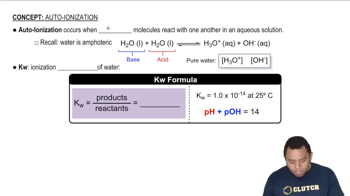
Water undergoes self-ionization, where two water molecules produce one hydroxide ion (OH<sup>-</sup>) and one hydronium ion (H<sub>3</sub>O<sup>+</sup>). This process is essential for understanding the concentration of H<sub>3</sub>O<sup>+</sup> ions in pure water, which occurs at a very low level.
Recommended video:
Guided course
02:22
Auto-Ionization and Kw

pH and Concentration of Ions

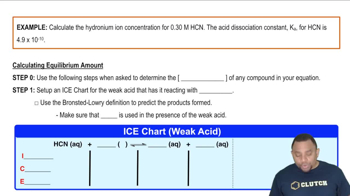
The pH scale measures the acidity or basicity of a solution, defined as the negative logarithm of the H<sub>3</sub>O<sup>+</sup> concentration. In pure water at 25 °C, the pH is 7, indicating that the concentration of H<sub>3</sub>O<sup>+</sup> ions is 1.0 x 10<sup>-7</sup> M, which is crucial for calculating the number of ions in a given volume.
Recommended video:
Guided course
06:25
Hydronium Ion Concentration Example

Avogadro's Number

Avogadro's number (6.022 x 10<sup>23</sup> entities/mol) is used to convert between moles of a substance and the number of individual particles, such as ions. To find the total number of H<sub>3</sub>O<sup>+</sup> ions in 1.0 mL of water, one must first calculate the number of moles in that volume and then use Avogadro's number to determine the total count of ions.