
The probe of the pH meter shown here is sitting in a beaker that contains a clear liquid. You are told the liquid is pure water, a solution of HCl(aq), or a solution of KOH(aq). (b) If the liquid is one of the solutions, what is its molarity?
Ch.16 - Acid-Base Equilibria
Brown14th EditionChemistry: The Central ScienceISBN: 9780134414232Not the one you use?Change textbook
Chapter 16, Problem 3
The indicator methyl orange has been added to both of the following solutions. Based on the colors, classify each statement as true or false: (a) The pH of solution A is definitely less than 7.00. (b) The pH of solution B is definitely greater than 7.00. (c) The pH of solution B is greater than that of solution A.
Verified step by step guidance1
insert step 1> Understand that methyl orange is a pH indicator that changes color depending on the acidity or basicity of a solution.
insert step 2> Recall that methyl orange changes from red at a pH of 3.1 to yellow at a pH of 4.4.
insert step 3> Consider the color of solution A after adding methyl orange. If the solution is red, it indicates a pH less than 3.1. If it is yellow, the pH is above 4.4.
insert step 4> If solution A is orange, it suggests a pH between 3.1 and 4.4.
insert step 5> Conclude that if solution A is red or orange, the pH is definitely less than 7.00. If it is yellow, further information is needed to determine if the pH is less than 7.00.
Key Concepts
Here are the essential concepts you must grasp in order to answer the question correctly.
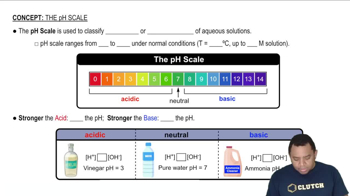
pH Scale
The pH scale measures the acidity or basicity of a solution, ranging from 0 to 14. A pH less than 7 indicates an acidic solution, while a pH greater than 7 indicates a basic solution. A pH of exactly 7 is considered neutral. Understanding the pH scale is essential for interpreting the results of acid-base indicators like methyl orange.
Recommended video:
Guided course
The pH Scale
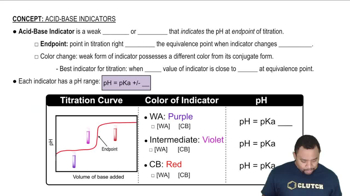
Acid-Base Indicators
Acid-base indicators are substances that change color in response to changes in pH. Methyl orange, for example, turns red in acidic solutions (pH < 3.1) and yellow in neutral to basic solutions (pH > 4.4). Knowing how these indicators behave at different pH levels helps in determining the acidity or basicity of a solution based on its color.
Recommended video:
Guided course
Acid-Base Indicators
Color Change Interpretation
Interpreting the color change of an indicator in a solution is crucial for determining its pH. If methyl orange is red, it suggests the solution is acidic (pH < 3.1), while a yellow color indicates a neutral or basic solution (pH > 4.4). This understanding allows for accurate classification of the solution's pH based on the observed color.
Recommended video:
Guided course
Chemical Changes
Related Practice
Textbook Question
1100
views
Textbook Question
The following diagrams represent aqueous solutions of three acids, HX, HY, and HZ. The water molecules have been omitted for clarity, and the hydrated proton is represented as H+ rather than H3O+.(b) Which acid would have the smallest aciddissociation constant, Ka?
546
views
Textbook Question
The following diagrams represent aqueous solutions of three acids, HX, HY, and HZ. The water molecules have been omitted for clarity, and the hydrated proton is represented as H+ rather than H3O+. (a) Which of the acids is a strong acid? Explain.
588
views
