
Pyridinium bromide 1C5H5NHBr2 is a strong electrolyte that dissociates completely into C5H5NH+ and Br-. An aqueous solution of pyridinium bromide has a pH of 2.95. (c) A solution of pyridinium bromide has a pH of 2.95. What is the concentration of the pyridinium cation at equilibrium, in units of molarity?
Ch.16 - Acid-Base Equilibria
Brown14th EditionChemistry: The Central ScienceISBN: 9780134414232Not the one you use?Change textbook
Chapter 16, Problem 80b
Using data from Appendix D, calculate 3OH-4 and pH for each of the following solutions: (b) 0.035 M Na2S
Verified step by step guidance1
Identify the relevant chemical species in the solution. Sodium sulfide (Na2S) dissociates in water to form 2 Na^+ ions and 1 S^2- ion.
Recognize that the sulfide ion (S^2-) can react with water in a hydrolysis reaction to form hydroxide ions (OH^-). The reaction is: S^{2-} + H_2O \(\rightleftharpoons\) HS^- + OH^-.
Write the equilibrium expression for the hydrolysis reaction. The equilibrium constant for this reaction is the base dissociation constant, K_b, which can be found using the relationship K_w = K_a \(\times\) K_b, where K_w is the ion-product constant of water and K_a is the acid dissociation constant for the conjugate acid (HS^-).
Calculate the concentration of OH^- ions produced by the hydrolysis of S^2-. Use the initial concentration of S^2- (0.035 M) and the equilibrium expression to solve for [OH^-].
Determine the pH of the solution. First, calculate the pOH using the concentration of OH^- ions: \(\text{pOH}\) = -\(\log\)[OH^-]. Then, use the relationship \(\text{pH}\) + \(\text{pOH}\) = 14 to find the pH.
Key Concepts
Here are the essential concepts you must grasp in order to answer the question correctly.
Dissociation of Sodium Sulfide (Na2S)
Sodium sulfide (Na2S) dissociates in water to produce sodium ions (Na+) and sulfide ions (S2-). The sulfide ion can further react with water to form hydroxide ions (OH-) and hydrogen sulfide (H2S), leading to an increase in the concentration of OH- in the solution. Understanding this dissociation is crucial for calculating the concentration of hydroxide ions in the solution.
Recommended video:
Guided course
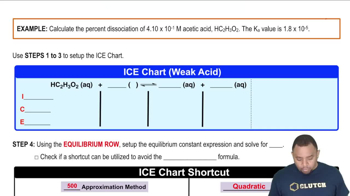
Percent Dissociation Example
Hydroxide Ion Concentration (OH-)
The concentration of hydroxide ions (OH-) is a key factor in determining the basicity of a solution. In this case, the dissociation of Na2S produces OH- ions, which can be calculated based on the stoichiometry of the reaction. The concentration of OH- is essential for calculating the pH of the solution, as it directly influences the acidity or basicity.
Recommended video:
Guided course
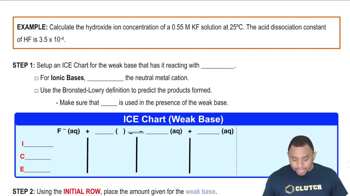
Hydroxide Ion Concentration Example
pH Calculation
pH is a measure of the acidity or basicity of a solution, defined as the negative logarithm of the hydrogen ion concentration (H+). For basic solutions, pH can be calculated using the relationship between pH and pOH, where pH + pOH = 14. By first determining the concentration of OH- from the dissociation of Na2S, one can find pOH and subsequently calculate the pH of the solution.
Recommended video:
Guided course
pH Calculation Example
Related Practice
Textbook Question
457
views
Textbook Question
Predict whether aqueous solutions of the following compounds are acidic, basic, or neutral: (c) Na2CO3
1047
views
Textbook Question
Pyridinium bromide 1C5H5NHBr2 is a strong electrolyte that dissociates completely into C5H5NH+ and Br-. An aqueous solution of pyridinium bromide has a pH of 2.95. (b) Using Appendix D, calculate the Ka for pyridinium bromide.
577
views
Textbook Question
Given that Kb for ammonia is 1.8 × 10⁻⁵ and that for hydroxylamine is 1.1 × 10⁻⁸, which is the stronger base?
1115
views
Textbook Question
Which is the stronger acid, the ammonium ion or the hydroxylammonium ion?
1
views
