
Ch.17 - Additional Aspects of Aqueous Equilibria
Brown - Chemistry: The Central Science 14th Edition
Brown14th EditionChemistry: The Central ScienceISBN: 9780134414232Not the one you use?Change textbook
Chapter 17, Problem 4a

The following diagram represents a buffer composed of equal concentrations of a weak acid, HA, and its conjugate base, A-. The heights of the columns are proportional to the concentrations of the components of the buffer. (a) Which of the three drawings, (1), (2), or (3), represents the buffer after the addition of a strong acid? [Section 17.2]

Verified step by step guidance
1
Identify the components of the buffer: a weak acid (HA) and its conjugate base (A-).
Understand that adding a strong acid to the buffer will increase the concentration of H+ ions.
Recognize that the added H+ ions will react with the conjugate base (A-) to form more of the weak acid (HA).
Determine that the concentration of the conjugate base (A-) will decrease, while the concentration of the weak acid (HA) will increase.
Look for the drawing where the column representing HA is taller and the column representing A- is shorter compared to the original buffer.

Key Concepts

Here are the essential concepts you must grasp in order to answer the question correctly.

Buffer Solutions

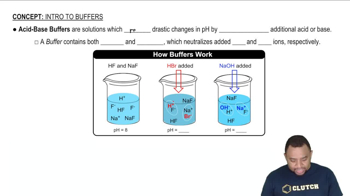
A buffer solution is a system that resists changes in pH upon the addition of small amounts of acid or base. It typically consists of a weak acid and its conjugate base in equilibrium. This equilibrium allows the buffer to neutralize added acids or bases, maintaining a relatively stable pH.
Recommended video:
Guided course
03:02
Buffer Solutions

Weak Acids and Conjugate Bases

Weak acids partially dissociate in solution, establishing an equilibrium between the undissociated acid (HA) and its ions (H+ and A-). The conjugate base (A-) can react with added H+ ions from a strong acid, minimizing the change in pH. Understanding this equilibrium is crucial for predicting how a buffer will respond to external changes.

Effect of Strong Acid on Buffer

When a strong acid is added to a buffer solution, it increases the concentration of H+ ions. The weak acid component of the buffer will react with these H+ ions, shifting the equilibrium and converting some of the conjugate base (A-) into more weak acid (HA). This process helps to mitigate the pH change, but the buffer's capacity is limited and can be overwhelmed if too much strong acid is added.
Recommended video:
Guided course
01:14
Effective Buffer Range