
Tooth enamel is composed of hydroxyapatite, whose simplest formula is Ca51PO423OH, and whose corresponding Ksp = 6.8 * 10-27. As discussed in the Chemistry and Life box on page 746, fluoride in fluorinated water or in toothpaste reacts with hydroxyapatite to form fluoroapatite, Ca51PO423F, whose Ksp = 1.0 * 10-60. (a) Write the expression for the solubility-constant for hydroxyapatite and for fluoroapatite.
Ch.17 - Additional Aspects of Aqueous Equilibria
Brown14th EditionChemistry: The Central ScienceISBN: 9780134414232Not the one you use?Change textbook
Chapter 17, Problem 99
The solubility of CaCO3 is pH dependent. (a) Calculate the molar solubility of CaCO3 given Ksp = 4.5 * 10^-92, neglecting the acid-base character of the carbonate ion. (c) If we assume that the only sources of Ca2+, HCO3-, and OH- ions are from the dissolution of CaCO3, what is the molar solubility of CaCO3 using the equilibrium expression from part (b)?
Verified step by step guidance1
Identify the dissolution reaction of calcium carbonate (CaCO3) in water: CaCO3(s) ⇌ Ca²⁺(aq) + CO₃²⁻(aq).
Write the expression for the solubility product constant (Ksp) for the dissolution of CaCO3: Ksp = [Ca²⁺][CO₃²⁻].
Assume the molar solubility of CaCO3 is 's'. At equilibrium, [Ca²⁺] = s and [CO₃²⁻] = s. Substitute these into the Ksp expression: Ksp = s * s = s².
Solve for 's' by taking the square root of both sides: s = √(Ksp). Substitute the given Ksp value (4.5 * 10^-92) into the equation to find the molar solubility.
For part (c), consider the equilibrium expression from part (b) and the assumption that the only sources of ions are from CaCO3. Set up the equilibrium expressions for the dissolution and any additional equilibria involving HCO3⁻ and OH⁻, and solve for the molar solubility using these expressions.
Key Concepts
Here are the essential concepts you must grasp in order to answer the question correctly.
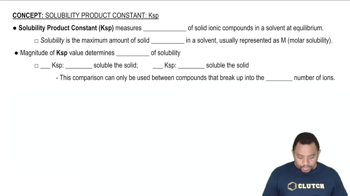
Solubility Product Constant (Ksp)
The solubility product constant (Ksp) is an equilibrium constant that applies to the solubility of sparingly soluble ionic compounds. It is defined as the product of the molar concentrations of the ions, each raised to the power of their coefficients in the balanced equation. For calcium carbonate (CaCO3), Ksp = [Ca2+][CO3^2-]. Understanding Ksp is crucial for calculating the molar solubility of CaCO3 in different pH conditions.
Recommended video:
Guided course
Solubility Product Constant
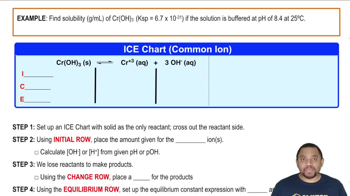
pH and its Effect on Solubility
pH is a measure of the acidity or basicity of a solution, which can significantly influence the solubility of certain compounds. In the case of CaCO3, an increase in pH (more basic conditions) can lead to a decrease in the concentration of carbonate ions (CO3^2-), thus affecting its solubility. This relationship is essential for understanding how the dissolution of CaCO3 varies with changes in pH.
Recommended video:
Guided course
Solubility at Buffered pH Example
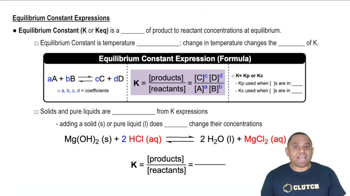
Equilibrium Expressions
Equilibrium expressions describe the relationship between the concentrations of reactants and products at equilibrium. For the dissolution of CaCO3, the equilibrium expression can be derived from its dissociation into Ca2+ and CO3^2- ions. This expression is vital for calculating molar solubility, as it allows for the determination of ion concentrations based on the Ksp value and the stoichiometry of the dissolution reaction.
Recommended video:
Guided course
Equilibrium Constant Expressions
Related Practice
Textbook Question
1667
views
Textbook Question
The solubility of CaCO3 is pH dependent. (b) Use the Kb expression for the CO32- ion to determine the equilibrium constant for the reaction CaCO3(s) + H2O(l) ⇌ Ca2+(aq) + HCO3-(aq) + OH-(aq)
1551
views
Textbook Question
For each pair of compounds, use Ksp values to determine which has the greater molar solubility: (a) CdS or CuS (b) PbCO3 or BaCrO4 (c) Ni(OH)2 or NiCO3 (d) AgI or Ag2SO4.
773
views
Textbook Question
Lead(II) carbonate, PbCO3, is one of the components of the passivating layer that forms inside lead pipes. (d) The EPA threshold for acceptable levels of lead ions in water is 15 ppb. Does a saturated solution of lead(II) carbonate produce a solution that exceeds the EPA limit?
1153
views
