
A sample of 0.1687 g of an unknown monoprotic acid was dissolved in 25.0 mL of water and titrated with 0.1150 M NaOH. The acid required 15.5 mL of base to reach the equivalence point. (b) After 7.25 mL of base had been added in the titration, the pH was found to be 2.85. What is the Ka for the unknown acid?
Ch.17 - Additional Aspects of Aqueous Equilibria
Brown14th EditionChemistry: The Central ScienceISBN: 9780134414232Not the one you use?Change textbook
Chapter 17, Problem 94
What is the pH of a solution made by mixing 0.30 mol NaOH, 0.25 mol Na2HPO4, and 0.20 mol H3PO4 with water and diluting to 1.00 L?
Verified step by step guidance1
Step 1: Identify the species present in the solution. NaOH is a strong base, Na2HPO4 is a salt that can act as a weak base, and H3PO4 is a weak acid.
Step 2: Determine the reactions that will occur. NaOH will react with H3PO4 to form water and Na2HPO4. Write the balanced chemical equation for this reaction: \[ \text{NaOH} + \text{H}_3\text{PO}_4 \rightarrow \text{Na}_2\text{HPO}_4 + \text{H}_2\text{O} \].
Step 3: Calculate the moles of each reactant and product after the reaction. Use stoichiometry to determine the limiting reactant and the amount of each species remaining or formed.
Step 4: Determine the dominant species in the solution after the reaction. Consider the remaining moles of NaOH, Na2HPO4, and H3PO4 to identify the predominant acid-base pair.
Step 5: Use the Henderson-Hasselbalch equation to calculate the pH of the solution. The equation is \[ \text{pH} = \text{pK}_a + \log \left( \frac{[\text{A}^-]}{[\text{HA}]} \right) \], where \([\text{A}^-]\) is the concentration of the conjugate base and \([\text{HA}]\) is the concentration of the weak acid.
Key Concepts
Here are the essential concepts you must grasp in order to answer the question correctly.
pH and pOH
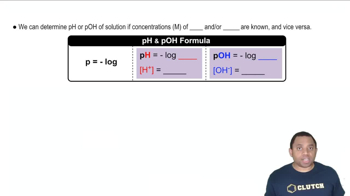
pH is a measure of the acidity or basicity of a solution, defined as the negative logarithm of the hydrogen ion concentration (pH = -log[H+]). A pH less than 7 indicates an acidic solution, while a pH greater than 7 indicates a basic solution. Understanding pH is crucial for determining the nature of the solution formed by mixing different substances.
Recommended video:
Guided course
pH and pOH Calculations
Buffer Solutions
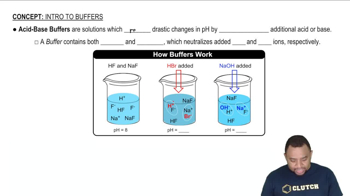
A buffer solution is a system that resists changes in pH upon the addition of small amounts of acid or base. In this case, the combination of Na2HPO4 (a weak base) and H3PO4 (a weak acid) can create a buffer system. The Henderson-Hasselbalch equation can be used to calculate the pH of such a buffer solution, which is essential for understanding the final pH of the mixed solution.
Recommended video:
Guided course
Buffer Solutions
Stoichiometry of Acid-Base Reactions
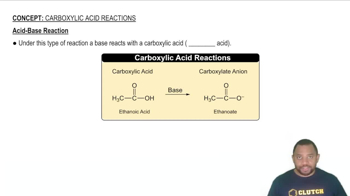
Stoichiometry involves the calculation of reactants and products in chemical reactions. In this scenario, the amounts of NaOH, Na2HPO4, and H3PO4 must be considered to determine how they interact in solution. The neutralization reaction between the strong base (NaOH) and the weak acid (H3PO4) will affect the overall pH, making it important to analyze the stoichiometric relationships between these components.
Recommended video:
Guided course
Acid-Base Reaction
Related Practice
Textbook Question
2137
views
1
rank
Textbook Question
A sample of 0.2140 g of an unknown monoprotic acid was dissolved in 25.0 mL of water and titrated with 0.0950 M NaOH. The acid required 30.0 mL of base to reach the equivalence point. (a) What is the molar mass of the acid?
1096
views
Textbook Question
Mathematically prove that the pH at the halfway point of a titration of a weak acid with a strong base (where the volume of added base is half of that needed to reach the equivalence point) is equal to pKa for the acid.
567
views
Textbook Question
Suppose you want to do a physiological experiment that calls for a pH 6.50 buffer. You find that the organism with which you are working is not sensitive to the weak acid H2A 1Ka1 = 2 * 10-2; Ka2 = 5.0 * 10-72 or its sodium salts. You have available a 1.0 M solution of this acid and a 1.0 M solution of NaOH. How much of the NaOH solution should be added to 1.0 L of the acid to give a buffer at pH 6.50? (Ignore any volume change.)
647
views
