
You have to prepare a pH = 3.50 buffer, and you have the following 0.10 M solutions available: HCOOH, CH3COOH, H3PO4, HCOONa, CH3COONa, and NaH2PO4. How many milliliters of each solution would you use to make approximately 1 L of the buffer?
Ch.17 - Additional Aspects of Aqueous Equilibria
Brown14th EditionChemistry: The Central ScienceISBN: 9780134414232Not the one you use?Change textbook
Chapter 17, Problem 32b
You have to prepare a pH = 5.00 buffer, and you have the following 0.10 M solutions available: HCOOH, HCOONa, CH3COOH, CH3COONa, HCN, and NaCN. How many milliliters of each solution would you use to make approximately 1 L of the buffer?
Verified step by step guidance1
insert step 1> Identify the appropriate acid-base pair for the buffer. Since you need a pH of 5.00, choose the acid with a pKa close to 5.00. Compare the pKa values of HCOOH, CH3COOH, and HCN to find the best match.
insert step 2> Use the Henderson-Hasselbalch equation: \( \text{pH} = \text{pKa} + \log \left( \frac{[\text{A}^-]}{[\text{HA}]} \right) \). Substitute the desired pH and the pKa of the chosen acid to find the ratio \( \frac{[\text{A}^-]}{[\text{HA}]} \).
insert step 3> Calculate the concentrations of the acid (HA) and its conjugate base (A-) needed to achieve the desired pH. Use the ratio from the Henderson-Hasselbalch equation and the fact that the total concentration of the buffer components should be approximately 0.10 M.
insert step 4> Determine the volumes of the acid and conjugate base solutions required to achieve the calculated concentrations. Use the formula \( C_1V_1 = C_2V_2 \) to find the volumes, where \( C_1 \) and \( C_2 \) are the initial and final concentrations, and \( V_1 \) and \( V_2 \) are the initial and final volumes.
insert step 5> Adjust the volumes calculated in the previous step to ensure the total volume of the buffer solution is approximately 1 L. Verify that the pH is close to 5.00 using the Henderson-Hasselbalch equation.

Verified video answer for a similar problem:
This video solution was recommended by our tutors as helpful for the problem above.
Video duration:
5mWas this helpful?
Key Concepts
Here are the essential concepts you must grasp in order to answer the question correctly.
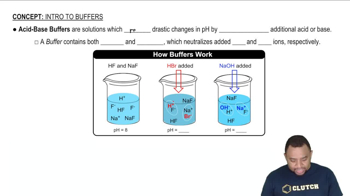
Buffer Solutions
A buffer solution is a system that resists changes in pH upon the addition of small amounts of acid or base. It typically consists of a weak acid and its conjugate base or a weak base and its conjugate acid. In this case, the pH of 5.00 indicates the need for a weak acid and its salt to maintain the desired acidity.
Recommended video:
Guided course
Buffer Solutions
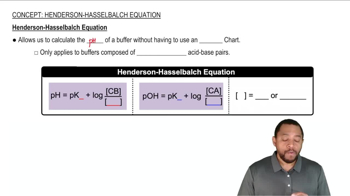
Henderson-Hasselbalch Equation
The Henderson-Hasselbalch equation relates the pH of a buffer solution to the concentration of its acid and conjugate base. It is expressed as pH = pKa + log([A-]/[HA]), where pKa is the acid dissociation constant. This equation is essential for calculating the required ratios of the weak acid and its salt to achieve the target pH.
Recommended video:
Guided course
Henderson-Hasselbalch Equation
Concentration and Dilution
Concentration refers to the amount of solute present in a given volume of solution, typically expressed in molarity (M). When preparing a buffer, understanding how to mix different concentrations and volumes of solutions is crucial to achieve the desired final concentration in the buffer. This involves calculating the volumes of the available solutions needed to reach 1 L of the buffer at pH 5.00.
Recommended video:
Guided course
Dilution Equation
Related Practice
Textbook Question
Textbook Question
(b) What is the ratio of HCO3- to H2CO3 in an exhausted marathon runner whose blood pH is 7.1?
542
views
Textbook Question
The accompanying graph shows the titration curves for two monoprotic acids. (d) Estimate the pKa of the weak acid.
561
views
Textbook Question
Compare the titration of a strong, monoprotic acid with a strong base to the titration of a weak, monoprotic acid with a strong base. Assume the strong and weak acid solutions initially have the same concentrations. Indicate whether the following statements are true or false. (a) More base is required to reach the equivalence point for the strong acid than the weak acid.
1095
views
1
rank
Textbook Question
(a) What is the ratio of HCO3- to H2CO3 in blood of pH 7.4?
1960
views
