Ch.19 - Chemical Thermodynamics
Brown - Chemistry: The Central Science 14th Edition
Brown14th EditionChemistry: The Central ScienceISBN: 9780134414232Not the one you use?Change textbook
Chapter 19, Problem 91

Ammonium nitrate dissolves spontaneously and endothermally in water at room temperature. What can you deduce about the sign of ΔS for this dissolution process?

Verified step by step guidance
1
Step 1: Understand the process: Ammonium nitrate dissolving in water is a physical process where the solid ammonium nitrate dissociates into its ions in the aqueous solution.
Step 2: Recognize the nature of the process: The dissolution is spontaneous and endothermic, meaning it absorbs heat from the surroundings.
Step 3: Apply the Gibbs Free Energy equation: The spontaneity of a process is determined by the Gibbs Free Energy change (ΔG), where ΔG = ΔH - TΔS. For a process to be spontaneous, ΔG must be negative.
Step 4: Analyze the terms: Since the process is endothermic, ΔH is positive. For ΔG to be negative (spontaneous process), the TΔS term must be large enough to overcome the positive ΔH.
Step 5: Deduce the sign of ΔS: Since TΔS must be positive and large to make ΔG negative, ΔS (change in entropy) must be positive, indicating an increase in disorder as the solid dissolves into ions.

Key Concepts

Here are the essential concepts you must grasp in order to answer the question correctly.

Dissolution Process

The dissolution process involves a solute (in this case, ammonium nitrate) interacting with a solvent (water) to form a solution. This process can be influenced by temperature, pressure, and the nature of the solute and solvent. Understanding how solutes dissolve helps in predicting the thermodynamic behavior of solutions.

Enthalpy Change (ΔH)

Enthalpy change (ΔH) refers to the heat absorbed or released during a chemical process at constant pressure. In the case of ammonium nitrate, the dissolution is described as endothermic, meaning it absorbs heat from the surroundings. This characteristic influences the overall energy balance of the dissolution process and is crucial for understanding the thermodynamic favorability.

Entropy Change (ΔS)

Entropy change (ΔS) is a measure of the disorder or randomness in a system. A positive ΔS indicates an increase in disorder, while a negative ΔS suggests a decrease. In the context of ammonium nitrate dissolving in water, the spontaneous nature of the process implies that despite being endothermic, the increase in disorder from solute particles dispersing in the solvent leads to a positive ΔS.
Recommended video:
Guided course
01:46
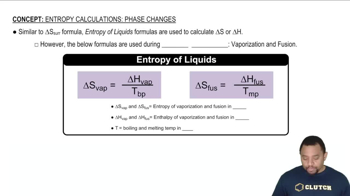
Entropy in Phase Changes
Related Practice
Textbook Question

For each of the following processes, indicate whether the signs of ΔS and ΔH are expected to be positive, negative, or about zero. (a) A solid sublimes. (b) The temperature of a sample of Co(s) is lowered from 60 °C to 25 °C. (c) Ethyl alcohol evaporates from a beaker. (d) A diatomic molecule dissociates into atoms. (e) A piece of charcoal is combusted to form CO2(g) and H2O(g).

794
views
Textbook Question

A standard air conditioner involves a refrigerant that is typically now a fluorinated hydrocarbon, such as CH2F2. An air-conditioner refrigerant has the property that it readily vaporizes at atmospheric pressure and is easily compressed to its liquid phase under increased pressure. The operation of an air conditioner can be thought of as a closed system made up of the refrigerant going through the two stages shown here (the air circulation is not shown in this diagram).

During expansion, the liquid refrigerant is released into an expansion chamber at low pressure, where it vaporizes. The vapor then undergoes compression at high pressure back to its liquid phase in a compression chamber. (c) In a central air-conditioning system, one chamber is inside the home and the other is outside. Which chamber is where, and why?

375
views
Textbook Question

Trouton’s rule states that for many liquids at their normal boiling points, the standard molar entropy of vaporization is about 88 J/mol‐K. b. Look up the normal boiling point of Br2 in a chemistry handbook or at the WebElements website (www.webelements.com) and compare it to your calculation. What are the possible sources of error, or incorrect assumptions, in the calculation?

2574
views
Textbook Question

The crystalline hydrate Cd(NO3)2⋅4 H2O(s) loses water when placed in a large, closed, dry vessel at room temperature: Cd(NO3)2⋅4 H2O(s) → Cd(NO3)2(s) + 4 H2O(g) This process is spontaneous and ΔH° is positive at room temperature.

(b) If the hydrated compound is placed in a large, closed vessel that already contains a large amount of water vapor, does ΔS° change for this reaction at room temperature?

367
views