
A system goes from state 1 to state 2 and back to state 1. (c) Suppose the changes in state are reversible processes. Is the work done by the system upon going from state 1 to state 2 the same or different as compared to that upon going from state 2 back to state 1?
Ch.19 - Chemical Thermodynamics
Brown14th EditionChemistry: The Central ScienceISBN: 9780134414232Not the one you use?Change textbook
Chapter 19, Problem 17a
Consider a process in which an ideal gas changes from state 1 to state 2 in such a way that its temperature changes from 300 K to 200 K. (a) Does the temperature change depend on whether the process is reversible or irreversible?
Verified step by step guidance1
insert step 1> Understand that temperature is a state function, which means it depends only on the initial and final states of the system, not on the path taken to get from one to the other.
insert step 2> Recognize that in this problem, the temperature change is from 300 K to 200 K, which are the initial and final states.
insert step 3> Since temperature is a state function, the change in temperature (\( \Delta T \)) is the same regardless of whether the process is reversible or irreversible.
insert step 4> Conclude that the temperature change does not depend on the nature of the process (reversible or irreversible).
insert step 5> Reiterate that the key concept here is the state function property of temperature, which ensures that \( \Delta T = T_{final} - T_{initial} \) is path-independent.

Verified video answer for a similar problem:
This video solution was recommended by our tutors as helpful for the problem above.
Video duration:
2mWas this helpful?
Key Concepts
Here are the essential concepts you must grasp in order to answer the question correctly.
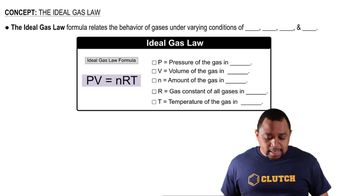
Ideal Gas Law
The Ideal Gas Law describes the relationship between pressure, volume, temperature, and the number of moles of an ideal gas. It is expressed as PV = nRT, where P is pressure, V is volume, n is the number of moles, R is the ideal gas constant, and T is temperature in Kelvin. Understanding this law is crucial for analyzing gas behavior during state changes.
Recommended video:
Guided course
Ideal Gas Law Formula
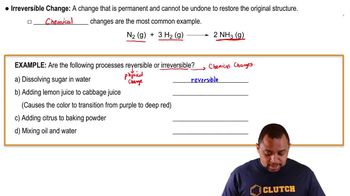
Reversible vs. Irreversible Processes
Reversible processes are idealized processes that can be reversed without any net change in the system or surroundings, while irreversible processes cannot return to their original state without external work. The distinction affects how energy is transferred and how temperature changes occur, but the temperature change itself is a state function and does not depend on the path taken.
Recommended video:
Guided course
Reversible vs Irreversible Example
State Functions
State functions are properties that depend only on the current state of a system, not on the path taken to reach that state. Examples include temperature, pressure, and volume. In the context of the question, the change in temperature from 300 K to 200 K is a state function, meaning it remains the same regardless of whether the process is reversible or irreversible.
Recommended video:
Guided course
Logarithmic Functions
Related Practice
Textbook Question
675
views
Textbook Question
Consider a process in which an ideal gas changes from state 1 to state 2 in such a way that its temperature changes from 300 K to 200 K. (b) Is this process isothermal?
505
views
Textbook Question
Consider the vaporization of liquid water to steam at a pressure of 1 atm. (d) At what temperature are the two phases in equilibrium?
790
views
Textbook Question
Consider a system consisting of an ice cube. (a) Under what conditions can the ice cube melt reversibly?
477
views
Textbook Question
The normal freezing point of n-octane (C8H18) is -57 °C. (b) In what temperature range is the freezing of n-octane a spontaneous process?
749
views
Textbook Question
Consider the vaporization of liquid water to steam at a pressure of 1 atm. (c) In what temperature range is it a nonspontaneous process?
361
views
