
Ch.19 - Chemical Thermodynamics
Brown - Chemistry: The Central Science 14th Edition
Brown14th EditionChemistry: The Central ScienceISBN: 9780134414232Not the one you use?Change textbook
Chapter 19, Problem 23a

The normal boiling point of Br2(l) is 58.8 °C, and its molar enthalpy of vaporization is ΔHvap = 29.6 kJ/mol. (a) When Br2(l) boils at its normal boiling point, does its entropy increase or decrease?

Verified step by step guidance
1
Identify the phase change occurring: Boiling is a phase change from liquid to gas.
Understand the nature of the phases: In the liquid phase, molecules are more ordered compared to the gas phase where molecules are more dispersed and have higher randomness.
Relate entropy to randomness: Entropy, a measure of disorder or randomness in a system, increases when a substance transitions from a more ordered state (liquid) to a less ordered state (gas).
Apply this understanding to the boiling of Br2(l): As Br2(l) boils and changes from liquid to gas, the entropy of the system increases due to the increased disorder and freedom of movement of the gas molecules compared to the liquid.
Conclude the effect on entropy: Therefore, when Br2(l) boils at its normal boiling point, its entropy increases.

Verified video answer for a similar problem:

This video solution was recommended by our tutors as helpful for the problem above.
Video duration:
1m
Was this helpful?

Key Concepts

Here are the essential concepts you must grasp in order to answer the question correctly.

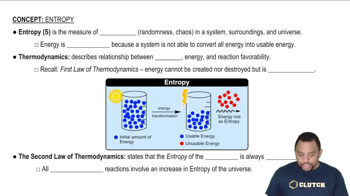
Entropy

Entropy is a measure of the disorder or randomness in a system. In thermodynamics, it is often associated with the number of ways a system can be arranged. When a substance transitions from a liquid to a gas, such as bromine (Br2) boiling, the molecules move from a more ordered state to a less ordered state, leading to an increase in entropy.
Recommended video:
Guided course
02:46
Entropy in Thermodynamics

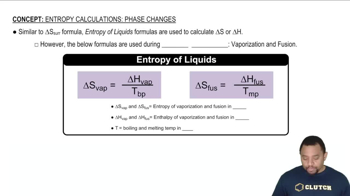
Phase Change

A phase change refers to the transition of a substance from one state of matter to another, such as from liquid to gas during boiling. This process involves energy changes, specifically the enthalpy of vaporization, which is the energy required to convert a unit amount of a liquid into vapor at its boiling point. Understanding phase changes is crucial for analyzing changes in entropy.
Recommended video:
Guided course
01:46
Entropy in Phase Changes

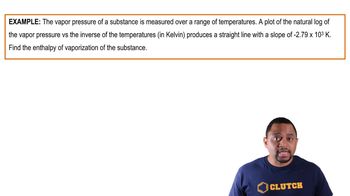
Enthalpy of Vaporization

The enthalpy of vaporization (ΔHvap) is the amount of energy required to convert one mole of a liquid into vapor at constant temperature and pressure. For bromine, this value is 29.6 kJ/mol. This energy input not only facilitates the phase change but also contributes to the increase in entropy, as the molecules in the gas phase have greater freedom of movement compared to those in the liquid phase.
Recommended video:
Guided course
01:37
Enthalpy of Vaporization Example
Related Practice
Textbook Question

A system goes from state 1 to state 2 and back to state 1. (c) Suppose the changes in state are reversible processes. Is the work done by the system upon going from state 1 to state 2 the same or different as compared to that upon going from state 2 back to state 1?

675
views
Textbook Question

The normal boiling point of Br2(𝑙) is 58.8 °C, and its molar enthalpy of vaporization is Δ𝐻vap=29.6kJ/mol. (b) Calculate the value of Δ𝑆 when 1.00 mol of Br2(𝑙) is vaporized at 58.8 °C.

443
views
Textbook Question

The element gallium (Ga) freezes at 29.8 °C, and its molar enthalpy of fusion is ΔHfus = 5.59 kJ/mol. (a) When molten gallium solidifies to Ga(s) at its normal melting point, is ΔS positive or negative?

1332
views
Textbook Question

Indicate whether each statement is true or false. (a) ΔS is a state function. (b) If a system undergoes a reversible change, the entropy of the universe increases. (c) If a system undergoes a reversible process, the change in entropy of the system is exactly matched by an equal and opposite change in the entropy of the surroundings. (d) If a system undergoes a reversible process, the entropy change of the system must be zero.

919
views
Textbook Question

The element gallium (Ga) freezes at 29.8 °C, and its molar enthalpy of fusion is ΔHfus = 5.59 kJ/mol. (b) Calculate the value of ΔS when 60.0 g of Ga(l) solidifies at 29.8 °C.

871
views
Textbook Question
Consider a system consisting of an ice cube. (a) Under what conditions can the ice cube melt reversibly?
477
views