Consider a reaction A2(𝑔) + B2(𝑔) ⇌ 2 AB(𝑔), atoms of A shown in red in the diagram and atoms of B shown in blue. (a) If 𝐾𝑐 = 1, which box represents the system at equilibrium?
Ch.19 - Chemical Thermodynamics
Brown14th EditionChemistry: The Central ScienceISBN: 9780134414232Not the one you use?Change textbook
Chapter 19, Problem 8
Using data from Appendix C, write the equilibrium-constant expression and calculate the value of the equilibrium constant and the free-energy change for these reactions at 298 K: (b) 2 HBr(g) + Cl2(g) ⇌ 2 HCl(g) + Br2(g) (c) 2 SO2(g) + O2(g) ⇌ 2 SO3(g)
Verified step by step guidance1
Step 1: Write the equilibrium-constant expression for each reaction. For a general reaction aA + bB ⇌ cC + dD, the equilibrium constant expression Kc is given by \( K_c = \frac{[C]^c[D]^d}{[A]^a[B]^b} \). Apply this to each reaction.
Step 2: For reaction (b) 2 HBr(g) + Cl2(g) ⇌ 2 HCl(g) + Br2(g), the equilibrium-constant expression is \( K_c = \frac{[HCl]^2[Br_2]}{[HBr]^2[Cl_2]} \).
Step 3: For reaction (c) 2 SO2(g) + O2(g) ⇌ 2 SO3(g), the equilibrium-constant expression is \( K_c = \frac{[SO_3]^2}{[SO_2]^2[O_2]} \).
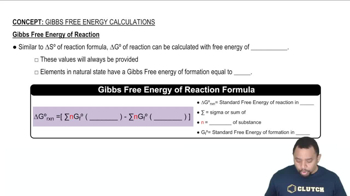
Step 4: Use the standard Gibbs free energy change equation \( \Delta G^\circ = -RT \ln K \) to relate the equilibrium constant to the free energy change. Here, R is the gas constant (8.314 J/mol·K) and T is the temperature in Kelvin (298 K).
Step 5: Calculate \( \Delta G^\circ \) for each reaction using \( \Delta G^\circ = \sum \Delta G^\circ_{\text{products}} - \sum \Delta G^\circ_{\text{reactants}} \) with values from Appendix C, then solve for K using \( K = e^{-\Delta G^\circ / RT} \).
Key Concepts
Here are the essential concepts you must grasp in order to answer the question correctly.
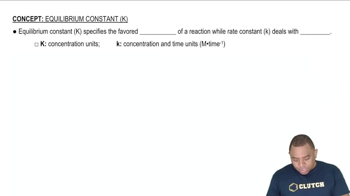
Equilibrium Constant (K)
The equilibrium constant (K) is a numerical value that expresses the ratio of the concentrations of products to reactants at equilibrium for a given reaction at a specific temperature. It is derived from the balanced chemical equation and is calculated using the formula K = [products]^[coefficients] / [reactants]^[coefficients]. A large K value indicates that products are favored at equilibrium, while a small K value suggests that reactants are favored.
Recommended video:
Guided course
Equilibrium Constant K
Gibbs Free Energy (ΔG)
Gibbs free energy (ΔG) is a thermodynamic quantity that indicates the spontaneity of a reaction at constant temperature and pressure. It is calculated using the equation ΔG = ΔG° + RT ln(Q), where ΔG° is the standard free energy change, R is the universal gas constant, T is the temperature in Kelvin, and Q is the reaction quotient. A negative ΔG indicates a spontaneous reaction, while a positive ΔG suggests non-spontaneity.
Recommended video:
Guided course
Gibbs Free Energy of Reactions
Reaction Quotient (Q)
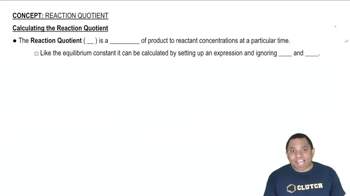
The reaction quotient (Q) is a measure of the relative concentrations of products and reactants at any point in a reaction, not necessarily at equilibrium. It is calculated similarly to the equilibrium constant but uses the current concentrations instead of equilibrium concentrations. Comparing Q to K helps predict the direction in which a reaction will proceed to reach equilibrium: if Q < K, the reaction will shift to the right (toward products), and if Q > K, it will shift to the left (toward reactants).
Recommended video:
Guided course
Reaction Quotient Q
Related Practice
Textbook Question
319
views
Textbook Question
The accompanying diagram shows how ΔH (red line) and TΔS (blue line) change with temperature for a hypothetical reaction.
(b) In what temperature range is this reaction spontaneous?
519
views
Textbook Question
The accompanying diagram shows how entropy varies with temperature for a substance that is a gas at the highest temperature shown. (c) If this substance is a perfect crystal at T = 0 K, what is the value of S at this temperature?
494
views
Textbook Question
Which of the following processes are spontaneous and which are nonspontaneous: (d) lightning
944
views
1
rank
Textbook Question
Which of the following processes are spontaneous and which are nonspontaneous: (e) formation of CH4 and O2 molecules from CO2 and H2O at room temperature and 1 atm of pressure?
1390
views