Ch.2 - Atoms, Molecules, and Ions
Brown - Chemistry: The Central Science 14th Edition
Brown14th EditionChemistry: The Central ScienceISBN: 9780134414232Not the one you use?Change textbook
Chapter 2, Problem 91a

(a) Assuming the dimensions of the nucleus and atom shown in Figure 2.10, what fraction of the volume of the atom is taken up by the nucleus?

Verified step by step guidance
1
insert step 1: Understand the problem by identifying the given information. You need the dimensions of both the nucleus and the atom. Assume the nucleus is a sphere with radius r_nucleus and the atom is a sphere with radius r_atom.
insert step 2: Use the formula for the volume of a sphere, V = \(\frac{4}{3}\)\(\pi\) r^3, to calculate the volume of the nucleus.
insert step 3: Similarly, use the same formula to calculate the volume of the atom.
insert step 4: Determine the fraction of the volume of the atom that is occupied by the nucleus by dividing the volume of the nucleus by the volume of the atom.
insert step 5: Simplify the expression to find the fraction, which will be a very small number, indicating that the nucleus occupies a tiny fraction of the atom's volume.

Verified video answer for a similar problem:

This video solution was recommended by our tutors as helpful for the problem above.
Video duration:
3m
Was this helpful?

Key Concepts

Here are the essential concepts you must grasp in order to answer the question correctly.

Atomic Structure

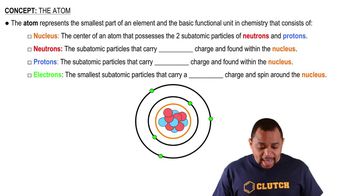
Atoms consist of a nucleus, which contains protons and neutrons, surrounded by electrons in various energy levels. The nucleus is significantly smaller than the entire atom, which includes the electron cloud. Understanding the relative sizes of these components is crucial for calculating volume fractions.
Recommended video:
Guided course
02:10
Atom Structure

Volume Calculation

The volume of a sphere can be calculated using the formula V = (4/3)πr³, where r is the radius. To find the fraction of the atom's volume occupied by the nucleus, one must calculate the volumes of both the atom and the nucleus and then divide the nucleus's volume by the atom's volume.
Recommended video:
Guided course
02:35
Constant-Volume Calorimetry

Fractional Volume

The fractional volume is a ratio that compares the volume of a part to the total volume. In this context, it is the volume of the nucleus divided by the volume of the atom, expressed as a decimal or percentage. This concept helps quantify how much space the nucleus occupies relative to the entire atom.
Recommended video:
Guided course
00:36
Mole Fraction Formula
Related Practice
Textbook Question

(b) Using the mass of the proton from Table 2.1 and assuming its diameter is 1.0 * 10-15 m, calculate the density of a proton in g>cm3.

623
views

Textbook Question

Identify the element represented by each of the following symbols and give the number of protons and neutrons in each: (a) 7433X

830
views
Textbook Question

The nucleus of 6Li is a powerful absorber of neutrons. It exists in the naturally occurring metal to the extent of 7.5%. In the era of nuclear deterrence, large quantities of lithium were processed to remove 6Li for use in hydrogen bomb production. The lithium metal remaining after removal of 6Li was sold on the market. (b) The atomic masses of 6Li and 7Li are 6.015122 and 7.016004 u, respectively. A sample of lithium depleted in the lighter isotope was found on analysis to contain 1.442% 6Li. What is the average atomic weight of this sample of the metal?

935
views
Textbook Question

The diameter of a rubidium atom is 495 pm We will consider two different ways of placing the atoms on a surface. In arrangement A, all the atoms are lined up with one another to form a square grid. Arrangement B is called a close-packed arrangement because the atoms sit in the 'depressions' formed by the previous row of atoms: (a) Using arrangement A, how many Rb atoms could be placed on a square surface that is 1.0 cm on a side?

488
views
Textbook Question

"The diameter of a rubidium atom is 495 pm We will consider two different ways of placing the atoms on a surface. In arrangement A, all the atoms are lined up with one another to form a square grid. Arrangement B is called a close-packed arrangement because the atoms sit in the 'depressions' formed by the previous row of atoms:

(c) If extended to three dimensions, which arrangement would lead to a greater density for Rb metal?"

806
views
Textbook Question

"The diameter of a rubidium atom is 495 pm We will consider two different ways of placing the atoms on a surface. In arrangement A, all the atoms are lined up with one another to form a square grid. Arrangement B is called a close-packed arrangement because the atoms sit in the 'depressions' formed by the previous row of atoms:

(c) By what factor has the number of atoms on the surface increased in going to arrangement B from arrangement A?

438
views