
Write the correct symbol, with both superscript and subscript, for each of the following. Use the list of elements in the front inside cover as needed: (d) the isotope of magnesium that has an equal number of protons and neutrons.
Ch.2 - Atoms, Molecules, and Ions
Brown14th EditionChemistry: The Central ScienceISBN: 9780134414232Not the one you use?Change textbook
Chapter 2, Problem 33b
(b) The atomic weight of boron is reported as 10.81, yet no atom of boron has the mass of 10.81 u. Explain.
Verified step by step guidance1
Understand that the atomic weight of an element is a weighted average of the masses of its isotopes, not the mass of a single atom.
Identify the isotopes of boron: Boron has two stable isotopes, Boron-10 and Boron-11.
Recognize that each isotope has a different mass: Boron-10 has a mass of approximately 10 u, and Boron-11 has a mass of approximately 11 u.
Consider the natural abundance of each isotope: Boron-10 and Boron-11 occur in nature in different proportions, with Boron-11 being more abundant.
Calculate the weighted average: The atomic weight of boron (10.81 u) is calculated by multiplying the mass of each isotope by its relative abundance and summing these values. This results in a value that does not correspond to the mass of any single boron atom but represents the average mass of boron atoms as they occur naturally.

Verified video answer for a similar problem:
This video solution was recommended by our tutors as helpful for the problem above.
Video duration:
2mWas this helpful?
Key Concepts
Here are the essential concepts you must grasp in order to answer the question correctly.
Atomic Weight vs. Atomic Mass
Atomic weight is a weighted average of the masses of an element's isotopes, reflecting their relative abundances in nature. In contrast, atomic mass refers to the mass of a specific isotope, measured in atomic mass units (u). Since boron has isotopes with different masses, the atomic weight of 10.81 u does not correspond to any single boron atom.
Recommended video:
Guided course
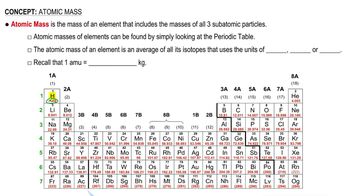
Atomic Mass
Isotopes
Isotopes are variants of a chemical element that have the same number of protons but different numbers of neutrons, resulting in different atomic masses. Boron has two stable isotopes: boron-10 (10 u) and boron-11 (11 u). The presence of these isotopes contributes to the average atomic weight of boron being 10.81 u, as it accounts for their relative abundances.
Recommended video:
Guided course
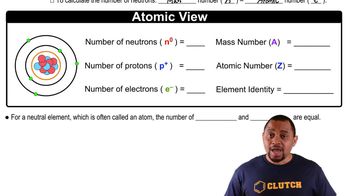
Isotopes
Relative Abundance
Relative abundance refers to the proportion of each isotope of an element found in a natural sample. For boron, the atomic weight of 10.81 u is calculated based on the relative abundances of its isotopes, boron-10 and boron-11. This average reflects the typical composition of boron in nature, rather than the mass of any individual atom.
Recommended video:
Guided course
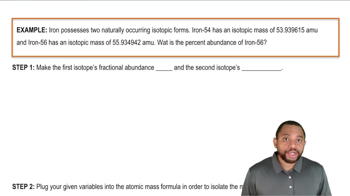
Calculating Abundance Example
Related Practice
Textbook Question
554
views
Textbook Question
(a) What isotope is used as the standard in establishing the atomic mass scale?
758
views
Textbook Question
Rubidium has two naturally occurring isotopes, rubidium-85 (atomic mass = 84.9118 amu; abundance = 72.15%) and rubidium-87 (atomic mass = 86.9092 amu; abundance = 27.85%). Calculate the atomic weight of rubidium
6608
views
Textbook Question
(a) What is the mass in u of a carbon-12 atom?
Textbook Question
Only two isotopes of copper occur naturally: 63Cu (atomic mass = 62.9296 amu; abundance 69.17%) 65Cu (atomic mass = 64.9278 amu; abundance 30.83%). Calculate the atomic weight (average atomic mass) of copper.
4359
views
Textbook Question
Without doing any detailed calculations (but using a periodic table to give atomic weights), rank the following samples in order of increasing numbers of atoms: 0.2 mol PCl5 molecules, 80 g Fe2O3, 3.0 3 1023 CO molecules.
1078
views
