
Sodium reacts with oxygen in air to form two compounds: sodium oxide and sodium peroxide. In forming sodium oxide, 23.0 g of sodium combines with 8.0 g of hydrogen. In forming sodium peroxide, 23.0 g of sodium combines with 16.0 g of oxygen. (a) What are the mass ratios of oxygen in the two compounds?
Ch.2 - Atoms, Molecules, and Ions
Brown14th EditionChemistry: The Central ScienceISBN: 9780134414232Not the one you use?Change textbook
Chapter 2, Problem 10a
In the Millikan oil-drop experiment (see Figure 2.5), the tiny oil drops are observed through the viewing lens as rising, stationary, or falling, as shown here. (a) What causes their rate of fall to vary from their rate in the absence of an electric field?
Verified step by step guidance1
Understand the role of gravity and buoyancy: In the absence of an electric field, the rate of fall of the oil drops is primarily influenced by two forces: gravity, which pulls the drops downward, and buoyancy, which acts upward against gravity. The balance between these forces determines the terminal velocity of the drops.
Recognize the introduction of the electric field: When an electric field is applied, it introduces an additional force on the charged oil drops. The direction and magnitude of this electric force depend on the charge of the drop and the strength and direction of the electric field.
Consider the effect of the electric force on charged particles: If the electric force is upward and the drop is negatively charged, it will oppose the force of gravity, potentially causing the drop to rise or fall more slowly. Conversely, if the electric force is downward, it will aid gravity, causing the drop to fall faster.
Analyze the balance of forces: The overall motion of the oil drop is a result of the vector sum of the gravitational force, buoyant force, and electric force. Changes in the electric field strength or direction can alter this balance, leading to variations in the rate of fall or rise of the drops.
Examine the stationary condition: When the oil drop appears stationary, it indicates that the upward forces (buoyant and electric, if upward) exactly balance the downward gravitational force, resulting in no net force and thus no acceleration.
Key Concepts
Here are the essential concepts you must grasp in order to answer the question correctly.
Electric Field
An electric field is a region around a charged particle where other charged particles experience a force. In the context of the Millikan oil-drop experiment, the electric field is created between two charged plates, influencing the motion of the oil droplets. When the field is applied, it exerts a force on the charged droplets, altering their rate of fall compared to when no field is present.
Recommended video:
Guided course
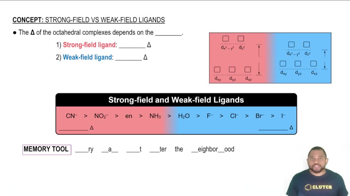
Strong-Field Ligands result in a large Δ and Weak-Field Ligands result in a small Δ.
Gravitational Force
Gravitational force is the attractive force between two masses, which in this experiment acts on the oil droplets due to Earth's gravity. This force causes the droplets to fall towards the ground. The balance between gravitational force and the electric force from the electric field determines whether the droplets rise, fall, or remain stationary.
Charge of the Droplets
The charge of the oil droplets is crucial in the Millikan experiment, as it determines how they interact with the electric field. Each droplet can acquire a charge through ionization or contact with charged surfaces. The magnitude and sign of this charge affect the force exerted by the electric field, thus influencing the droplets' motion and their observed rates of fall or rise.
Recommended video:
Guided course
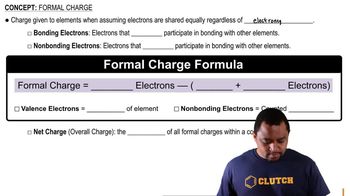
Formal Charge
Related Practice
Textbook Question
2
views
Textbook Question
Sodium reacts with oxygen in air to form two compounds: sodium oxide and sodium peroxide. In forming sodium oxide, 23.0 g of sodium combines with 8.0 g of hydrogen. In forming sodium peroxide, 23.0 g of sodium combines with 16.0 g of oxygen. (b) What fundamental law does this experiment demonstrate?
5861
views
Textbook Question
Five of the boxes in the following periodic table are colored. Predict the charge on the ion associated with each of these elements.
355
views
Textbook Question
A 1.0-g sample of carbon dioxide (CO2) is fully decomposed into its elements, yielding 0.273 g of carbon and 0.727 g of oxygen. (a) What is the ratio of the mass of O to C?
753
views
Textbook Question
Which of the following diagrams most likely represents an ionic compound, and which represents a molecular one? Explain your choice.
865
views
1
rank
