Ch.20 - Electrochemistry
Brown - Chemistry: The Central Science 14th Edition
Brown14th EditionChemistry: The Central ScienceISBN: 9780134414232Not the one you use?Change textbook
Chapter 20, Problem 89

(a) What is electrolysis? (b) Are electrolysis reactions thermodynamically spontaneous?

Verified step by step guidance
1
Electrolysis is a chemical process that uses electrical energy to drive a non-spontaneous chemical reaction. It typically involves the decomposition of compounds into their elements or simpler compounds.
In electrolysis, an external voltage is applied to a chemical cell, causing a redox reaction to occur. This process is the opposite of what happens in a galvanic cell, where a spontaneous redox reaction generates electrical energy.
To determine if electrolysis reactions are thermodynamically spontaneous, we need to consider the Gibbs free energy change (ΔG) of the reaction. A reaction is spontaneous if ΔG is negative.
For electrolysis reactions, the Gibbs free energy change is positive (ΔG > 0), indicating that these reactions are not spontaneous and require an input of energy to proceed.
In summary, electrolysis involves non-spontaneous reactions that require electrical energy to occur, as indicated by a positive Gibbs free energy change.

Key Concepts

Here are the essential concepts you must grasp in order to answer the question correctly.

Electrolysis

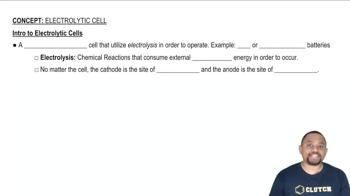
Electrolysis is a chemical process that uses electrical energy to drive a non-spontaneous reaction. It involves the decomposition of a substance, typically an ionic compound, into its constituent elements or simpler compounds through the application of an electric current. This process occurs in an electrolytic cell, where oxidation and reduction reactions take place at the anode and cathode, respectively.
Recommended video:
Guided course
01:21
The Electrolytic Cell

Spontaneity of Reactions

A reaction is considered thermodynamically spontaneous if it occurs without the need for continuous external energy input. This is determined by the change in Gibbs free energy (ΔG); if ΔG is negative, the reaction is spontaneous. In contrast, electrolysis reactions are non-spontaneous, meaning they require an external energy source to proceed, as they have a positive ΔG under standard conditions.

Gibbs Free Energy

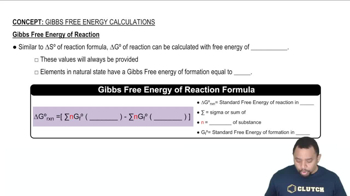
Gibbs free energy is a thermodynamic potential that measures the maximum reversible work obtainable from a thermodynamic system at constant temperature and pressure. It is a crucial factor in determining the spontaneity of a reaction. The relationship between Gibbs free energy, enthalpy, and entropy is given by the equation ΔG = ΔH - TΔS, where ΔH is the change in enthalpy, T is the temperature in Kelvin, and ΔS is the change in entropy.
Recommended video:
Guided course
01:51
Gibbs Free Energy of Reactions