

The capacity of batteries such as the typical AA alkaline battery is expressed in units of milliamp-hours (mAh). An AA alkaline battery yields a nominal capacity of 2850 mAh. (b) The starting voltage of a fresh alkaline battery is 1.55 V. The voltage decreases during discharge and is 0.80 V when the battery has delivered its rated capacity. If we assume that the voltage declines linearly as current is withdrawn, estimate the total maximum electrical work the battery could perform during discharge.
Ch.20 - Electrochemistry
Brown14th EditionChemistry: The Central ScienceISBN: 9780134414232Not the one you use?Change textbook
Chapter 20, Problem 104
(b) Given the following reduction potentials, calculate the standard emf of the cell: Cd1OH221s2 + 2 e- ¡ Cd1s2 + 2 OH-1aq2 E°red = -0.76 V NiO1OH21s2 + H2O1l2 + e- ¡ Ni1OH221s2 + OH-1aq2 E°red = +0.49 V
Verified step by step guidance1
Identify the two half-reactions and their standard reduction potentials: Cd(OH)2(s) + 2e^- -> Cd(s) + 2OH^-(aq) with E°_red = -0.76 V and NiO(OH)(s) + H2O(l) + e^- -> Ni(OH)2(s) + OH^-(aq) with E°_red = +0.49 V.
Determine which half-reaction will be the oxidation and which will be the reduction. The half-reaction with the more positive reduction potential will proceed as the reduction, and the other will be reversed to act as the oxidation.
Reverse the half-reaction with the less positive (or more negative) reduction potential to represent oxidation. This means reversing the Cd(OH)2 half-reaction: Cd(s) + 2OH^-(aq) -> Cd(OH)2(s) + 2e^- and changing its sign to E°_ox = +0.76 V.
Calculate the standard cell potential (E°_cell) by adding the standard reduction potential of the reduction half-reaction to the standard oxidation potential of the oxidation half-reaction: E°_cell = E°_red (NiO(OH)) + E°_ox (Cd).
Substitute the values into the equation: E°_cell = +0.49 V + (+0.76 V) and simplify to find the standard emf of the cell.

Verified video answer for a similar problem:
This video solution was recommended by our tutors as helpful for the problem above.
Video duration:
5mWas this helpful?
Key Concepts
Here are the essential concepts you must grasp in order to answer the question correctly.
Standard Electrode Potentials
Standard electrode potentials (E°) are measured voltages that indicate the tendency of a chemical species to be reduced, with more positive values signifying a greater likelihood of reduction. These values are determined under standard conditions (1 M concentration, 1 atm pressure, and 25°C) and are essential for calculating the overall cell potential in electrochemical cells.
Recommended video:
Guided course
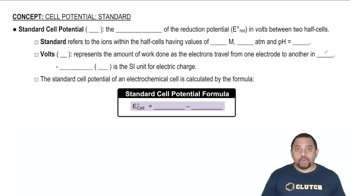
Standard Cell Potential
Cell Potential Calculation
The standard electromotive force (emf) of an electrochemical cell can be calculated using the formula E°cell = E°cathode - E°anode. In this context, the cathode is where reduction occurs, and the anode is where oxidation takes place. By substituting the given reduction potentials into this formula, one can determine the overall cell potential.
Recommended video:
Guided course
Standard Cell Potential
Oxidation and Reduction Reactions
In electrochemistry, oxidation refers to the loss of electrons, while reduction refers to the gain of electrons. Each half-reaction in a redox process involves either oxidation or reduction. Understanding which species is oxidized and which is reduced is crucial for correctly identifying the anode and cathode in a cell, which directly impacts the calculation of the cell potential.
Recommended video:
Guided course
Oxidation and Reduction Reactions
Related Practice
Textbook Question
9696
views
Textbook Question
A voltaic cell is constructed that uses the following half-cell reactions:
Cu+(aq) + e- → Cu(s)
I2(s) + 2 e- → 2 I-(aq)
The cell is operated at 298 K with [Cu+] = 0.25 M and [I-] = 0.035 M.
(a) Determine E for the cell at these concentrations.
2756
views
1
rank
Textbook Question
A voltaic cell is constructed that uses the following half-cell reactions:
Cu+(aq) + e- → Cu(s)
I2(s) + 2 e- → 2 I-(aq)
The cell is operated at 298 K with [Cu+] = 0.25 M and [I-] = 0.035 M.
(b) Which electrode is the anode of the cell?
(c) Is the answer to part (b) the same as it would be if the cell were operated under standard conditions?
3
views
