
Aqueous solutions of ammonia (NH3) and bleach (active ingredient NaOCl) are sold as cleaning fluids, but bottles of both of them warn: 'Never mix ammonia and bleach, as toxic gases may be produced.' One of the toxic gases that can be produced is chloroamine, NH2Cl. (a) What is the oxidation number of chlorine in bleach? (active ingredient NaOCl) are sold as cleaning fluids, but bottles of both of them warn: “Never mix ammonia and bleach, as toxic gases may be produced.” One of the toxic gases that can be produced is chloroamine, NH2Cl. (b) What is the oxidation number of chlorine in chloramine? (d) Another toxic gas that can be produced is nitrogen trichloride, NCl3. What is the oxidation number of N in nitrogen trichloride?
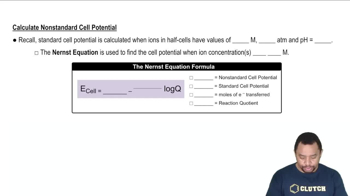
In a galvanic cell, the cathode is an Ag+ | 1.00 M | Ag(s) half-cell. The anode is a standard hydrogen electrode immersed in a buffer solution containing 0.10 M benzoic acid (C6H5COOH) and 0.050 M sodium benzoate (C6H5COO-Na+). The measured cell voltage is 1.030 V. What is the pKa of benzoic acid?
Verified step by step guidanceKey Concepts
Galvanic Cell
Nernst Equation
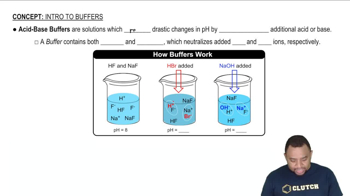
pKa and Buffer Solutions
Aqueous solutions of ammonia 1NH32 and bleach (active ingredient NaOCl) are sold as cleaning fluids, but bottles of both of them warn: 'Never mix ammonia and bleach, as toxic gases may be produced.' One of the toxic gases that can be produced is chloroamine, NH2Cl. (e) Is N oxidized, reduced, or neither, upon the conversion of ammonia to nitrogen trichloride?
Disulfides are compounds that have S ¬ S bonds, like peroxides have O ¬ O bonds. Thiols are organic compounds that have the general formula R ¬ SH, where R is a generic hydrocarbon. The SH- ion is the sulfur counterpart of hydroxide, OH-. Two thiols can react to make a disulfide, R ¬ S ¬ S ¬ R. (c) If you react two thiols to make a disulfide, are you oxidizing or reducing the thiols?
Calculate the number of kilowatt-hours of electricity required to produce 1.0 * 103 kg (1 metric ton) of aluminum by electrolysis of Al3+ if the applied voltage is 4.50 V and the process is 45% efficient.
