

Ch.20 - Electrochemistry
Brown - Chemistry: The Central Science 14th Edition
Brown14th EditionChemistry: The Central ScienceISBN: 9780134414232Not the one you use?Change textbook
Chapter 20, Problem 79

In a Li-ion battery, the composition of the cathode is LiCoO2 when completely discharged. On charging, approximately 50% of the Li+ ions can be extracted from the cathode and transported to the graphite anode where they intercalate between the layers. (b) If the LiCoO2 cathode has a mass of 10 g (when fully discharged), how many coulombs of electricity can be delivered on completely discharging a fully charged battery?

Verified step by step guidance
1
Step 1: Determine the molar mass of LiCoO_2 by adding the atomic masses of lithium (Li), cobalt (Co), and oxygen (O).
Step 2: Calculate the number of moles of LiCoO_2 in the 10 g cathode using the formula: \( \text{moles} = \frac{\text{mass}}{\text{molar mass}} \).
Step 3: Since 50% of the Li+ ions can be extracted, calculate the moles of Li+ ions that can be extracted from the moles of LiCoO_2.
Step 4: Use Faraday's constant (approximately 96485 C/mol) to convert the moles of Li+ ions to coulombs, as each mole of Li+ ions corresponds to one mole of electrons.
Step 5: Multiply the moles of Li+ ions by Faraday's constant to find the total charge in coulombs that can be delivered on completely discharging the battery.

Key Concepts

Here are the essential concepts you must grasp in order to answer the question correctly.

Stoichiometry of Lithium Extraction

In the context of LiCoO2, stoichiometry refers to the quantitative relationship between the lithium ions and the overall chemical reaction during charging and discharging. When the battery is charged, approximately 50% of the lithium ions (Li+) can be extracted, which is crucial for calculating the total charge delivered during discharge.

Faraday's Law of Electrolysis

Faraday's Law states that the amount of electric charge (in coulombs) required to transfer a certain amount of substance during an electrochemical reaction is directly proportional to the number of moles of electrons involved. This principle is essential for determining how many coulombs can be delivered based on the number of lithium ions extracted from the cathode.
Recommended video:
Guided course
01:40
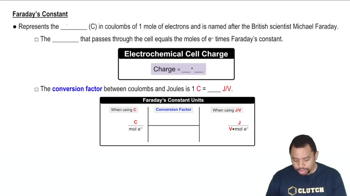
Faraday's Constant in Electrochemistry

Charge Calculation in Batteries

The total charge delivered by a battery can be calculated using the formula Q = n × F, where Q is the total charge in coulombs, n is the number of moles of electrons transferred, and F is Faraday's constant (approximately 96485 C/mol). Understanding this calculation is vital for determining the total coulombs delivered when the battery discharges completely.
Recommended video:
Guided course
00:59
Effective Nuclear Charge Calculation