
Textbook Question
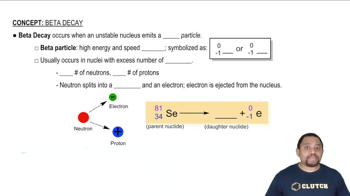
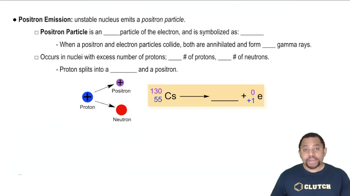
Predict the type of radioactive decay process for the following radionuclides: (c) phosphorus-32. (d) chlorine-39.

 Verified step by step guidance
 03:01
03:01
 01:53
01:53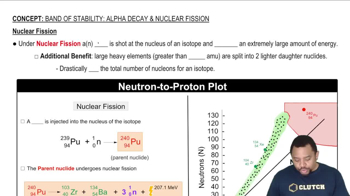 03:29
03:29Predict the type of radioactive decay process for the following radionuclides: (c) phosphorus-32. (d) chlorine-39.
Despite the similarities in the chemical reactivity of elements in the lanthanide series, their abundances in Earth's crust vary by two orders of magnitude. This graph shows the relative abundance as a function of atomic number. Which of the following statements best explains the sawtooth variation across the series? (a) The elements with an odd atomic number lie above the belt of stability. (b) The elements with an odd atomic number lie below the belt of stability. (c) The elements with an even atomic number have a magic number of protons. (d) Pairs of protons have a special stability.
Each of the following nuclei undergoes either beta decay or positron emission. Predict the type of emission for each: (a) tritium, 31H.
Predict the type of radioactive decay process for the following radionuclides: (b) 6829Cu.