
In the sketch below, the red spheres represent protons and the gray spheres represent neutrons. (c) Based on its atomic number and mass number, do you think the product nucleus is stable or radioactive? [Section 21.3]
Ch.21 - Nuclear Chemistry
Brown14th EditionChemistry: The Central ScienceISBN: 9780134414232Not the one you use?Change textbook
Chapter 21, Problem 6a
The accompanying graph illustrates the decay of 8842Mo, which decays via positron emission. (a) What is the halflife of the decay? [Section 21.4]

Verified step by step guidance1
Identify the initial mass of 7234Se from the graph at time t = 0 days.
Determine the mass of 7234Se at various time points to observe the decay pattern.
Find the time at which the mass of 7234Se is reduced to half of its initial value. This time is the half-life.
Verify the half-life by checking if the mass continues to halve at subsequent intervals of the same time period.
Conclude the half-life of 7234Se based on the consistent time intervals observed for the mass to reduce by half.

Verified video answer for a similar problem:
This video solution was recommended by our tutors as helpful for the problem above.
Video duration:
2mWas this helpful?
Key Concepts
Here are the essential concepts you must grasp in order to answer the question correctly.
Radioactive Decay
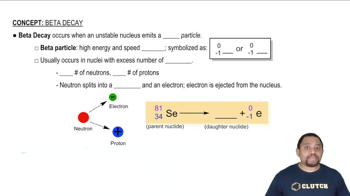
Radioactive decay is the process by which an unstable atomic nucleus loses energy by emitting radiation. This can occur in various forms, including alpha particles, beta particles, or gamma rays. In the case of positron emission, a proton in the nucleus is transformed into a neutron, releasing a positron and a neutrino. Understanding this process is crucial for analyzing the decay of isotopes like 88Mo.
Half-Life
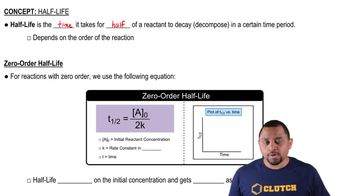
The half-life of a radioactive substance is the time required for half of the radioactive nuclei in a sample to decay. This concept is fundamental in nuclear chemistry and helps in predicting the behavior of radioactive materials over time. The half-life is a constant for each isotope and can be determined from decay graphs, where the time taken for the mass to reduce to half its initial value is measured.
Recommended video:
Guided course
Zero-Order Half-life
Decay Curve
A decay curve is a graphical representation of the decrease in the quantity of a radioactive substance over time. It typically shows an exponential decline, where the y-axis represents the remaining mass or activity, and the x-axis represents time. Analyzing the shape of the decay curve allows one to determine the half-life and understand the kinetics of the decay process, which is essential for solving problems related to radioactive isotopes.
Recommended video:
Guided course
Beta Decay
Related Practice
Textbook Question
500
views
1
rank
Textbook Question
All the stable isotopes of boron, carbon, nitrogen, oxygen, and fluorine are shown in the accompanying chart (in red), along with their radioactive isotopes with t1>2 7 1 min (in blue). (b) Which radioactive isotopes are most likely to decay by beta emission? [Sections 21.2, 21.4, and 21.5]
844
views
Textbook Question
The steps below show three of the steps in the radioactive decay chain for 23290Th. The half-life of each isotope is shown below the symbol of the isotope. (a) Identify the type of radioactive decay for each of the steps (i), (ii), and (iii). [Sections 21.2 and 21.4]
747
views
Textbook Question
The accompanying graph illustrates the decay of 8842Mo, which decays via positron emission. (c) What fraction of the original sample of 8842Mo remains after 12 min? [Section 21.4]
496
views
