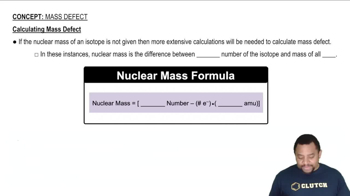
The atomic masses of nitrogen-14, titanium-48, and xenon-129 are 13.999234 amu, 47.935878 amu, and 128.904779 amu, respectively. For each isotope, calculate (a) the nuclear mass.
Ch.21 - Nuclear Chemistry
Brown14th EditionChemistry: The Central ScienceISBN: 9780134414232Not the one you use?Change textbook
Chapter 21, Problem 49c
The atomic masses of hydrogen-2 (deuterium), helium-4, and lithium-6 are 2.014102 amu, 4.002602 amu, and 6.0151228 amu, respectively. For each isotope, calculate
(c) the nuclear binding energy per nucleon.
Verified step by step guidance1
First, calculate the mass defect for each isotope. The mass defect is the difference between the sum of the masses of the individual nucleons (protons and neutrons) and the actual mass of the isotope. For each isotope, use the formula: Mass defect = (Z * mass of proton + (A - Z) * mass of neutron) - mass of isotope, where Z is the number of protons and A is the mass number.
Next, convert the mass defect from atomic mass units (amu) to kilograms (kg) for each isotope. Use the conversion factor: 1 amu = 1.66053906660 \( \times 10^{-27} \) kg.
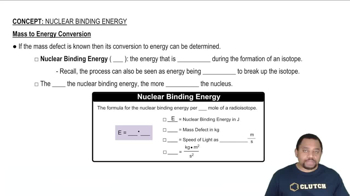
Calculate the nuclear binding energy for each isotope using Einstein's equation, E = mc^2, where m is the mass defect in kg and c is the speed of light in vacuum (approximately \( 2.998 \times 10^8 \) m/s).
Determine the number of nucleons (protons plus neutrons) for each isotope, which is the mass number A.
Finally, calculate the nuclear binding energy per nucleon for each isotope by dividing the total nuclear binding energy by the number of nucleons. This will give you the binding energy per nucleon in joules.

Verified video answer for a similar problem:
This video solution was recommended by our tutors as helpful for the problem above.
Video duration:
9mWas this helpful?
Key Concepts
Here are the essential concepts you must grasp in order to answer the question correctly.
Nuclear Binding Energy
Nuclear binding energy is the energy required to disassemble a nucleus into its individual protons and neutrons. It is a measure of the stability of a nucleus; the higher the binding energy, the more stable the nucleus. This energy arises from the strong nuclear force that holds the nucleons together, overcoming the repulsive electromagnetic force between protons.
Recommended video:
Guided course
Nuclear Binding Energy
Binding Energy per Nucleon
Binding energy per nucleon is calculated by dividing the total binding energy of a nucleus by the number of nucleons (protons and neutrons) it contains. This value provides insight into the stability of the nucleus relative to its size, allowing for comparisons between different isotopes. A higher binding energy per nucleon indicates a more stable nucleus.
Recommended video:
Guided course
Nuclear Binding Energy
Mass Defect
Mass defect refers to the difference between the mass of an assembled nucleus and the sum of the individual masses of its constituent protons and neutrons. This 'missing' mass is converted into energy, as described by Einstein's equation E=mc², and is directly related to the nuclear binding energy. Understanding mass defect is crucial for calculating the binding energy of isotopes.
Recommended video:
Guided course
Calculating Mass Defect
Related Practice
Textbook Question
654
views
Textbook Question
How much energy must be supplied to break a single aluminum-27 nucleus into separated protons and neutrons if an aluminum-27 atom has a mass of 26.9815386 amu? How much energy is required for 100.0 g of aluminum-27? (The mass of an electron is given on the inside back cover.)
714
views
Textbook Question
Based on the following atomic mass values: 1H, 1.00782 amu; 2H, 2.01410 amu; 3H, 3.01605 amu; 3He, 3.01603 amu; 4He, 4.00260 amu—and the mass of the neutron given in the text, calculate the energy released per mole in each of the following nuclear reactions, all of which are possibilities for a controlled fusion process:
(a) 21H + 31H → 42He + 10n
(b) 21H + 21H → 32He + 10n
(c) 21H + 32He → 42He + 11H
731
views