Ch.22 - Chemistry of the Nonmetals

Brown14th EditionChemistry: The Central ScienceISBN: 9780134414232
Not the one you use?Change textbookSelect a different textbook
Table of contents
- Ch.1 - Introduction: Matter, Energy, and Measurement140
- Ch.2 - Atoms, Molecules, and Ions192
- Ch.3 - Chemical Reactions and Reaction Stoichiometry172
- Ch.4 - Reactions in Aqueous Solution156
- Ch.5 - Thermochemistry151
- Ch.6 - Electronic Structure of Atoms137
- Ch.7 - Periodic Properties of the Elements127
- Ch.8 - Basic Concepts of Chemical Bonding143
- Ch.9 - Molecular Geometry and Bonding Theories167
- Ch.10 - Gases147
- Ch.11 - Liquids and Intermolecular Forces97
- Ch.12 - Solids and Modern Materials129
- Ch.13 - Properties of Solutions126
- Ch.14 - Chemical Kinetics175
- Ch.15 - Chemical Equilibrium107
- Ch.16 - Acid-Base Equilibria127
- Ch.17 - Additional Aspects of Aqueous Equilibria133
- Ch.18 - Chemistry of the Environment88
- Ch.19 - Chemical Thermodynamics140
- Ch.20 - Electrochemistry137
- Ch.21 - Nuclear Chemistry99
- Ch.22 - Chemistry of the Nonmetals66
- Ch.23 - Transition Metals and Coordination Chemistry69
- Ch.24 - The Chemistry of Life: Organic and Biological Chemistry11
Brown14th EditionChemistry: The Central ScienceISBN: 9780134414232Not the one you use?Change textbook

Chapter 22, Problem 35c
Explain each of the following observations:
c. The boiling point of HF is much higher than those of the other hydrogen halides.
 Verified step by step guidance
1
Identify the type of bonding and intermolecular forces present in HF and compare them with other hydrogen halides (HCl, HBr, HI).
Recognize that HF forms hydrogen bonds, which are stronger than the dipole-dipole interactions present in other hydrogen halides.
Understand that hydrogen bonding occurs when a hydrogen atom is covalently bonded to a highly electronegative atom (like fluorine) and is also attracted to another electronegative atom in a different molecule.
Consider the molecular structure and electronegativity of fluorine compared to chlorine, bromine, and iodine, which influences the strength of the hydrogen bonds in HF.
Conclude that the stronger hydrogen bonding in HF leads to higher energy requirements for molecules to escape from the liquid phase to the gas phase, resulting in a higher boiling point compared to other hydrogen halides.
Key Concepts
Here are the essential concepts you must grasp in order to answer the question correctly.
Hydrogen Bonding
Hydrogen bonding is a strong type of dipole-dipole interaction that occurs when hydrogen is bonded to highly electronegative atoms like fluorine, oxygen, or nitrogen. In HF, the hydrogen atom is attracted to the lone pair of electrons on the fluorine atom, leading to significant intermolecular forces. This results in a higher boiling point compared to other hydrogen halides, which do not exhibit such strong hydrogen bonding.
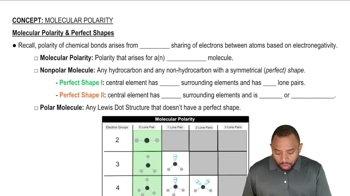
Molecular Structure and Polarity
The molecular structure and polarity of a compound significantly influence its physical properties, including boiling point. HF is a polar molecule due to the large electronegativity difference between hydrogen and fluorine, which creates a dipole moment. In contrast, other hydrogen halides like HCl, HBr, and HI are less polar, resulting in weaker intermolecular forces and lower boiling points.
Recommended video:
Guided course
 02:38
02:38
Molecular Polarity
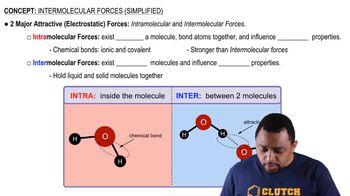
Intermolecular Forces
Intermolecular forces are the forces of attraction or repulsion between molecules, which play a crucial role in determining the boiling point of a substance. HF exhibits strong hydrogen bonds, while other hydrogen halides primarily rely on weaker van der Waals forces. The strength of these intermolecular forces directly correlates with the energy required to change a substance from liquid to gas, thus affecting boiling points.
Recommended video:
Guided course
 01:59
01:59Intermolecular vs Intramolecular Forces
Related Practice