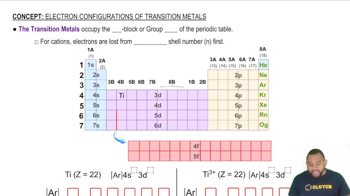
Write out the ground-state electron configurations of b. Ru²⁺
Ch.23 - Transition Metals and Coordination Chemistry
Brown14th EditionChemistry: The Central ScienceISBN: 9780134414232Not the one you use?Change textbook
Chapter 23, Problem 12
Complete the exercises below. Which periodic trend is partially responsible for the observation that the maximum oxidation state of the transition-metal elements peaks near groups 7B and 8B? a. The number of valence electrons reaches a maximum at group 8B. b. The effective nuclear charge increases on moving right across each period. c. The radii of the transition-metal elements reach a minimum for group 8B, and as the size of the atoms decreases it becomes easier to remove electrons.
Verified step by step guidance1
Step 1: Understand the periodic trends involved in the problem. The periodic table shows trends in properties such as atomic radius, ionization energy, and effective nuclear charge as you move across a period or down a group.
Step 2: Consider the trend of the number of valence electrons. In transition metals, the number of valence electrons generally increases as you move from left to right across a period, reaching a maximum at group 8B.
Step 3: Analyze the effective nuclear charge trend. As you move across a period from left to right, the effective nuclear charge experienced by the valence electrons increases, which can affect the ability of an atom to lose or gain electrons.
Step 4: Examine the trend in atomic radii. The atomic radius generally decreases across a period due to the increasing effective nuclear charge, which pulls the electron cloud closer to the nucleus.
Step 5: Relate these trends to the oxidation states of transition metals. The maximum oxidation state of transition metals is influenced by the number of valence electrons and the effective nuclear charge, which affects the ease of electron removal. Consider how these factors peak around groups 7B and 8B.
Key Concepts
Here are the essential concepts you must grasp in order to answer the question correctly.
Oxidation States of Transition Metals
The oxidation state of an element refers to the charge it would have if all bonds to atoms of different elements were fully ionic. Transition metals can exhibit multiple oxidation states due to their ability to lose different numbers of d and s electrons. The maximum oxidation state often correlates with the number of valence electrons available for bonding, which is particularly relevant in groups 7B and 8B.
Recommended video:
Guided course
Transition Metals
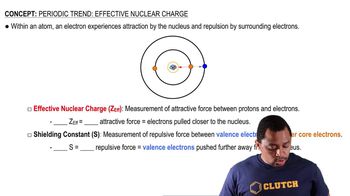
Effective Nuclear Charge
Effective nuclear charge (Z_eff) is the net positive charge experienced by an electron in a multi-electron atom. As you move across a period in the periodic table, Z_eff increases due to the addition of protons in the nucleus without a corresponding increase in shielding from inner electrons. This increase in Z_eff enhances the attraction between the nucleus and the valence electrons, influencing the oxidation states of transition metals.
Recommended video:
Guided course
Effective Nuclear Charge
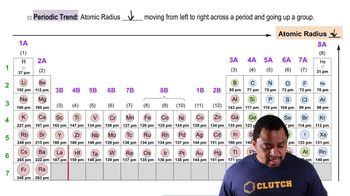
Periodic Trends in Atomic Radius
Atomic radius generally decreases across a period due to increasing nuclear charge, which pulls electrons closer to the nucleus. In transition metals, this trend affects the ease of electron removal; as the atomic radius decreases, it becomes energetically more favorable to remove electrons, thereby influencing the maximum oxidation states observed in groups 7B and 8B.
Recommended video:
Guided course
Atomic Radius Trends
Related Practice
Textbook Question
118
views
Textbook Question
Which of these crystal-field splitting diagrams represents:
a. a weak-field octahedral complex of Fe³⁺ ,
b. a strong-field octahedral complex of Fe³⁺
c. a tetrahedral complex of Fe³⁺
d. a tetrahedral complex of Ni²⁺ (The diagrams do not indicate the relative magnitudes of ∆. ) [Find more in Section 23.6.]
115
views
Textbook Question
In the linear crystal-field shown here, the negative charges are on the z-axis. Using Figure 23.28 as a guide, predict which of the following choices most accurately describes the splitting of the d orbitals in a linear crystal-field? [Find more in Section 23.6.]
108
views