
Detonation of nitroglycerin proceeds as follows: 4 C3H5N3O91l2¡ 12 CO21g2 + 6 N21g2 + O21g2 + 10 H2O1g2 (a) If a sample containing 2.00 mL of nitroglycerin 1density = 1.592 g>mL2 is detonated, how many moles of gas are produced?
Ch.3 - Chemical Reactions and Reaction Stoichiometry
Brown14th EditionChemistry: The Central ScienceISBN: 9780134414232Not the one you use?Change textbook
Chapter 3, Problem 68b
The complete combustion of octane, C8H18, a component of gasoline, proceeds as follows: 2 C8H18(l) + 25 O2(g) → 16 CO2(g) + 18 H2O(g) (b) How many grams of O2 are needed to burn 10.0 g of C8H18?
Verified step by step guidance1
Identify the balanced chemical equation for the combustion of octane: \(2 \text{C}_8\text{H}_{18} + 25 \text{O}_2 \rightarrow 16 \text{CO}_2 + 18 \text{H}_2\text{O}\).
Calculate the molar mass of octane (\(\text{C}_8\text{H}_{18}\)) by adding the atomic masses of carbon and hydrogen: \(8 \times 12.01 + 18 \times 1.01\).
Determine the number of moles of octane in 10.0 g by dividing the mass by the molar mass of octane.
Use the stoichiometry of the balanced equation to find the moles of \(\text{O}_2\) needed. According to the equation, 2 moles of \(\text{C}_8\text{H}_{18}\) require 25 moles of \(\text{O}_2\).
Convert the moles of \(\text{O}_2\) to grams by multiplying by the molar mass of \(\text{O}_2\) (32.00 g/mol).

Verified video answer for a similar problem:
This video solution was recommended by our tutors as helpful for the problem above.
Video duration:
2mWas this helpful?
Key Concepts
Here are the essential concepts you must grasp in order to answer the question correctly.
Stoichiometry
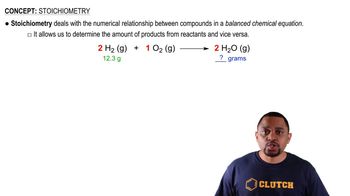
Stoichiometry is the branch of chemistry that deals with the quantitative relationships between the reactants and products in a chemical reaction. It allows chemists to calculate how much of each substance is needed or produced in a reaction based on balanced chemical equations. In this case, stoichiometry will help determine the amount of O2 required to combust a specific mass of octane.
Recommended video:
Guided course
Stoichiometry Concept
Molar Mass
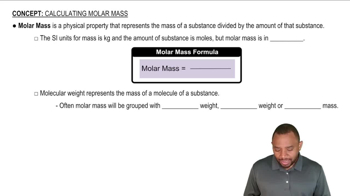
Molar mass is the mass of one mole of a substance, typically expressed in grams per mole (g/mol). It is essential for converting between the mass of a substance and the number of moles, which is necessary for stoichiometric calculations. For octane (C8H18), knowing its molar mass allows us to find out how many moles correspond to the given mass of 10.0 g.
Recommended video:
Guided course
Molar Mass Concept
Balanced Chemical Equation
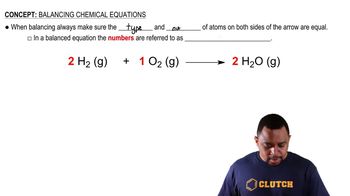
A balanced chemical equation represents a chemical reaction with equal numbers of each type of atom on both sides of the equation. It provides the mole ratios of reactants and products, which are crucial for stoichiometric calculations. In the combustion of octane, the balanced equation indicates the ratio of octane to oxygen, allowing us to calculate the required amount of O2 for complete combustion.
Recommended video:
Guided course
Balancing Chemical Equations
Related Practice
Textbook Question
1208
views
1
rank
Textbook Question
Calcium hydride reacts with water to form calcium hydroxide and hydrogen gas. (a) Write a balanced chemical equation for the reaction.
1512
views
Textbook Question
The combustion of one mole of liquid octane, CH3(CH2)6CH3, produces 5470 kJ of heat. Calculate how much heat is produced if 1.000 gallon of octane is combusted.
2565
views
Textbook Question
The complete combustion of octane, C8H18, a component of gasoline, proceeds as follows: 2 C8H18(l) + 25 O2(g) → 16 CO2(g) + 18 H2O(g) (a) How many moles of O2 are needed to burn 1.50 mol of C8H18?
1235
views
Textbook Question
Aluminum sulfide reacts with water to form aluminum hydroxide and hydrogen sulfide. (a) Write the balanced chemical equation for this reaction. (b) How many grams of aluminum hydroxide are obtained from 14.2 g of aluminum sulfide?
2481
views
