(a) What is the mass, in grams, of 1.223 mol of iron(III) sulfate? (b) How many moles of ammonium ions are in 6.955 g of ammonium carbonate? (c) What is the mass, in grams, of 1.50 * 1021 molecules of aspirin, C9H8O4?
Ch.3 - Chemical Reactions and Reaction Stoichiometry
Brown14th EditionChemistry: The Central ScienceISBN: 9780134414232Not the one you use?Change textbook
Chapter 3, Problem 39c
The molecular formula of allicin, the compound responsible for the characteristic smell of garlic, is C6H10OS2. (c) How many molecules of allicin are in 5.00 mg of this substance?
Verified step by step guidance1
Calculate the molar mass of allicin by adding the atomic masses of all the atoms in its molecular formula: C_6H_10OS_2.
Convert the mass of allicin from milligrams to grams by dividing by 1000.
Use the molar mass to convert the mass of allicin in grams to moles by dividing the mass by the molar mass.
Use Avogadro's number (6.022 \(\times\) 10^{23} molecules/mol) to convert the number of moles of allicin to the number of molecules by multiplying the moles by Avogadro's number.
The result from the previous step gives the number of molecules of allicin in 5.00 mg of the substance.

Verified video answer for a similar problem:
This video solution was recommended by our tutors as helpful for the problem above.
Video duration:
2mWas this helpful?
Key Concepts
Here are the essential concepts you must grasp in order to answer the question correctly.
Molecular Formula
A molecular formula indicates the number and type of atoms in a molecule. For allicin, C6H10OS2, it shows there are 6 carbon atoms, 10 hydrogen atoms, 1 oxygen atom, and 2 sulfur atoms. Understanding the molecular formula is essential for calculating the molar mass and determining the number of molecules in a given mass of the substance.
Molar Mass
The molar mass is the mass of one mole of a substance, typically expressed in grams per mole (g/mol). To find the number of molecules in a sample, you first calculate the molar mass of allicin using its molecular formula. This value allows you to convert the mass of the sample (in mg) to moles, which can then be used to find the number of molecules.
Recommended video:
Guided course
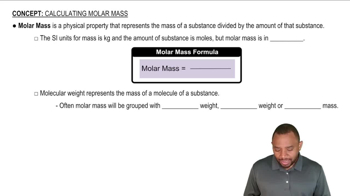
Molar Mass Concept
Avogadro's Number
Avogadro's number, approximately 6.022 x 10^23, is the number of particles (atoms, molecules, etc.) in one mole of a substance. This constant is crucial for converting moles of a substance into the actual number of molecules. Once the number of moles of allicin is determined from the mass, multiplying by Avogadro's number gives the total number of molecules present in the sample.
Related Practice
Textbook Question
798
views
Textbook Question
The molecular formula of aspartame, the artificial sweetener marketed as NutraSweet®, is C14H18N2O5. (a) What is the molar mass of aspartame?
1378
views
Textbook Question
The molecular formula of allicin, the compound responsible for the characteristic smell of garlic, is C6H10OS2. (b) How many moles of allicin are present in 5.00 mg of this substance?
592
views
Textbook Question
The molecular formula of aspartame, the artificial sweetener marketed as NutraSweet®, is C14H18N2O5. (c) How many molecules of aspartame are present in 1.00 mg of aspartame?
1173
views
Textbook Question
The molecular formula of aspartame, the artificial sweetener marketed as NutraSweet®, is C14H18N2O5. (d) How many hydrogen atoms are present in 1.00 mg of aspartame?
1025
views
Textbook Question
(d) What is the molar mass of diazepam (Valium®) if 0.05570 mol has a mass of 15.86 g?
593
views