
Write balanced chemical equations to correspond to each of the following descriptions: (a) When sulfur trioxide gas reacts with water, a solution of sulfuric acid forms. (b) Boron sulfide, B2S3(s), reacts violently with water to form dissolved boric acid, H3BO3, and hydrogen sulfide gas.
Ch.3 - Chemical Reactions and Reaction Stoichiometry
Brown14th EditionChemistry: The Central ScienceISBN: 9780134414232Not the one you use?Change textbook
Chapter 3, Problem 15
Write balanced chemical equations corresponding to each of the following descriptions: (a) Potassium cyanide reacts with an aqueous solution of sulfuric acid to form hydrogen cyanide gas. (b) When an aqueous solution of ammonium nitrite (NH4NO2) reacts with an aqueous solution of potassium hydroxide, ammonia gas, water and metal nitrate is formed. (c) When hydrogen gas is passed over solid hot iron(III) oxide, the resulting reaction produces iron and gaseous water. (d) When liquid ethanoic acid (CH3COOH) is combusted, carbon dioxide and water are formed.
Verified step by step guidance1
Identify the reactants and products in the reaction. The reactants are hydrogen gas (H2) and iron(III) oxide (Fe2O3), and the products are iron (Fe) and water (H2O) in the gaseous state.
Write the unbalanced chemical equation by placing the reactants on the left side and the products on the right side of the equation: \( \text{Fe}_2\text{O}_3 + \text{H}_2 \rightarrow \text{Fe} + \text{H}_2\text{O} \).
Balance the number of iron atoms. There are 2 iron atoms in iron(III) oxide, so you need 2 iron atoms in the products: \( \text{Fe}_2\text{O}_3 + \text{H}_2 \rightarrow 2\text{Fe} + \text{H}_2\text{O} \).
Balance the number of hydrogen atoms. There are 2 hydrogen atoms in each molecule of hydrogen gas and 2 hydrogen atoms in each molecule of water. To balance the hydrogen atoms, you need 3 molecules of hydrogen gas to produce 3 molecules of water: \( \text{Fe}_2\text{O}_3 + 3\text{H}_2 \rightarrow 2\text{Fe} + 3\text{H}_2\text{O} \).
Check that all atoms are balanced on both sides of the equation. In this case, there are 2 iron atoms, 6 hydrogen atoms, and 3 oxygen atoms on both sides, confirming that the equation is balanced.

Verified video answer for a similar problem:
This video solution was recommended by our tutors as helpful for the problem above.
Video duration:
2mWas this helpful?
Key Concepts
Here are the essential concepts you must grasp in order to answer the question correctly.
Chemical Reactions
A chemical reaction involves the transformation of reactants into products through the breaking and forming of chemical bonds. In this case, hydrogen gas reacts with iron(III) oxide, indicating a reduction-oxidation process where iron is reduced and hydrogen is oxidized.
Recommended video:
Guided course
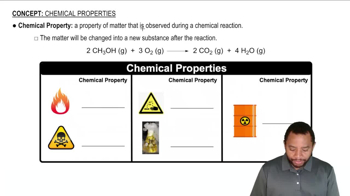
Chemical Properties
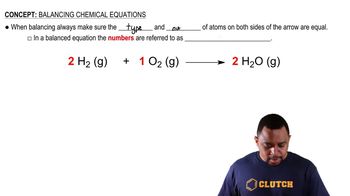
Balancing Chemical Equations
Balancing chemical equations is essential to ensure that the law of conservation of mass is upheld, meaning the number of atoms for each element must be the same on both sides of the equation. This involves adjusting coefficients in front of compounds to achieve equal numbers of each type of atom.
Recommended video:
Guided course
Balancing Chemical Equations
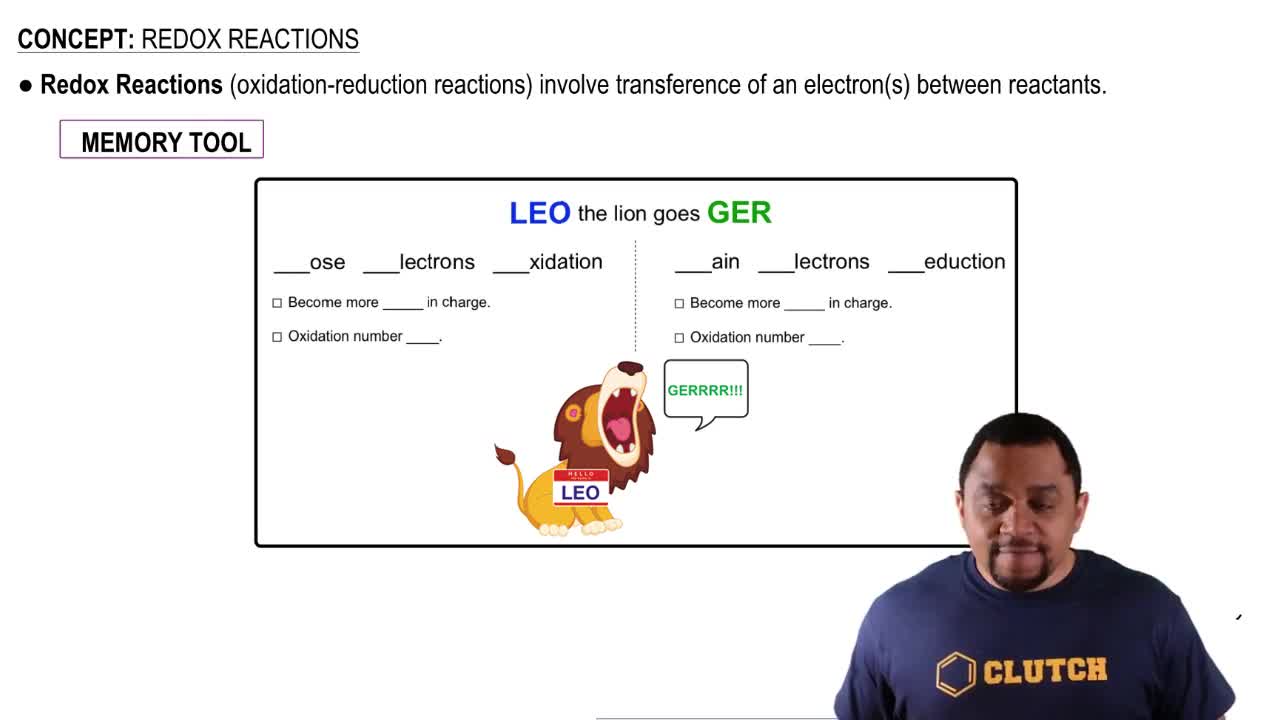
Oxidation-Reduction (Redox) Reactions
Oxidation-reduction reactions involve the transfer of electrons between substances, where one substance is oxidized (loses electrons) and another is reduced (gains electrons). In the given reaction, iron(III) oxide is reduced to iron, while hydrogen is oxidized to water, illustrating a classic redox process.
Recommended video:
Guided course
Oxidation and Reduction Reactions
Related Practice
Textbook Question
879
views
Textbook Question
Balance the following equations: (c) MnO2(s) + HCl(aq) → MnCl2(s) + H2O(l) + Cl2(g)
439
views
Textbook Question
Balance the following equations: (d) KOH(aq) + H3PO4(aq) → K3PO4(aq) + H2O(l)
360
views
Textbook Question
Write balanced chemical equations to correspond to each of the following descriptions: (c) Phosphine, PH3(g), combusts in oxygen gas to form water vapor and solid tetraphosphorus decaoxide.
509
views
Textbook Question
Balance the following equations: (a) CF4(l) + Br2(g) → CBr4(l) + F2(g) (b) Cu(s) + HNO3(aq) → Cu(NO3)2(aq) + NO2(g) + H2O(l)
451
views
