Ch.4 - Reactions in Aqueous Solution
Brown - Chemistry: The Central Science 14th Edition
Brown14th EditionChemistry: The Central ScienceISBN: 9780134414232Not the one you use?Change textbook
Chapter 4, Problem 95

Antacids are often used to relieve pain and promote healing in the treatment of mild ulcers. Write balanced net ionic equations for the reactions between the aqueous HCl in the stomach and each of the following substances used in various antacids: (a) Al(OH)3(s) (b) Mg(OH)2(s) (c) MgCO3(s) (d) NaAl(CO3)(OH)2(s) (e) CaCO3(s).

Verified step by step guidance
1
Identify the chemical formula of the antacid: NaAl(CO_3)(OH)_2.
Write the balanced chemical equation for the reaction between NaAl(CO_3)(OH)_2 and HCl: NaAl(CO_3)(OH)_2(s) + HCl(aq) -> products.
Determine the products of the reaction. Typically, the reaction will produce water, carbon dioxide, and a salt. Consider the decomposition of carbonate and hydroxide ions.
Write the complete ionic equation by breaking down all aqueous compounds into their ions.
Cancel out the spectator ions to write the net ionic equation, focusing on the ions that participate in the reaction.

Verified video answer for a similar problem:

This video solution was recommended by our tutors as helpful for the problem above.
Video duration:
5m
Was this helpful?

Key Concepts

Here are the essential concepts you must grasp in order to answer the question correctly.

Net Ionic Equations

Net ionic equations represent the actual chemical species that participate in a reaction, excluding spectator ions. They focus on the ions and molecules that undergo a change during the reaction, providing a clearer picture of the chemical processes involved. This is particularly useful in acid-base reactions, where the transfer of protons is the primary focus.

Acid-Base Reactions

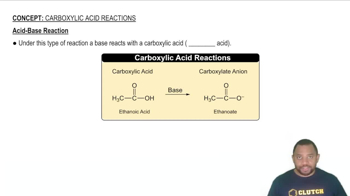
Acid-base reactions involve the transfer of protons (H+) from an acid to a base. In the context of antacids, the antacid neutralizes stomach acid (HCl) by reacting with it to form water and a salt. Understanding the properties of acids and bases, including their strength and dissociation in water, is essential for predicting the products of these reactions.
Recommended video:
Guided course
01:09
Acid-Base Reaction

Solubility and Precipitation

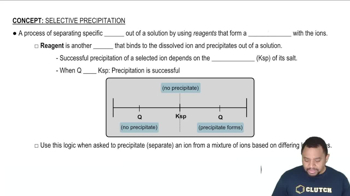
Solubility refers to the ability of a substance to dissolve in a solvent, while precipitation occurs when a solid forms from a solution during a chemical reaction. In the case of antacids, the solubility of the compounds involved, such as sodium aluminum carbonate, affects the reaction with hydrochloric acid and the formation of products. Recognizing which compounds are soluble or insoluble helps in writing accurate net ionic equations.
Recommended video:
Guided course
01:53
Selective Precipitation
Related Practice
Textbook Question

The accompanying photo shows the reaction between a solution of Cd(NO3)2 and one of Na2S. (b) What ions remain in solution?

354
views

Textbook Question

The commercial production of nitric acid involves the following chemical reactions:

4 NH3(g) + 5 O2(g) → 4 NO(g) + 6 H2O(g)

2 NO(g) + O2(g) → 2 NO2(g)

3 NO2(g) + H2O(l) → 2 HNO3(aq) + NO(g)

(c) How many grams of ammonia must you start with to make 1000.0 L of a 0.150 M aqueous solution of nitric acid? Assume all the reactions give 100% yield.

1255
views
Textbook Question

The commercial production of nitric acid involves the following chemical reactions:

4 NH3(g) + 5 O2(g) → 4 NO(g) + 6 H2O(g)

2 NO(g) + O2(g) → 2 NO2(g)

3 NO2(g) + H2O(l) → 2 HNO3(aq) + NO(g)

(a) Which of these reactions are redox reactions?

652
views
Textbook Question

The commercial production of nitric acid involves the following chemical reactions:

4 NH3(g) + 5 O2(g) → 4 NO(g) + 6 H2O(g)

2 NO(g) + O2(g) → 2 NO2(g)

3 NO2(g) + H2O(l) → 2 HNO3(aq) + NO(g)

(b) Identify the element undergoing oxidation and the element undergoing reduction.

365
views
Textbook Question

Uranium hexafluoride, UF6, is processed to produce fuel for nuclear reactors and nuclear weapons. UF6 can be produced in a two-step reaction. Solid uranium (IV) oxide, UO2, is first made to react with hydrofluoric acid (HF) solution to form solid UF4 with water as a by-product. UF4 further reacts with fluorine gas to form UF6. (a) Write the balanced molecular equations for the conversion of UO2 into UF4 and the conversion of UF4 to UF6. (b) Which step is an acid-base reaction?

931
views