
The distinctive odor of vinegar is due to acetic acid, CH3COOH, which reacts with sodium hydroxide according to: CH3COOH1aq2 + NaOH1aq2¡ H2O1l2 + NaCH3COO1aq2 If 3.45 mL of vinegar needs 42.5 mL of 0.115 M NaOH to reach the equivalence point in a titration, how many grams of acetic acid are in a 1.00-qt sample of this vinegar?
(b) How many milliliters of 0.125 M H2SO4 are needed to neutralize 0.200 g of NaOH?
Verified step by step guidance
Verified video answer for a similar problem:
Key Concepts
Molarity
Neutralization Reaction
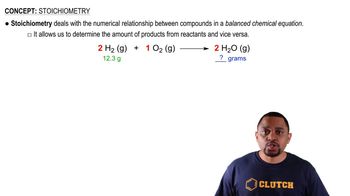
Stoichiometry
(a) How many milliliters of 0.120 M HCl are needed to completely neutralize 50.0 mL of 0.101 M Ba(OH)2 solution?
A 4.36-g sample of an unknown alkali metal hydroxide is dissolved in 100.0 mL of water. An acid–base indicator is added, and the resulting solution is titrated with 2.50 M HCl(aq) solution. The indicator changes color, signaling that the equivalence point has been reached, after 17.0 mL of the hydrochloric acid solution has been added. (b) What is the identity of the alkali metal cation: Li+, Na+, K+, Rb+, or Cs+?
(d) If 45.3 mL of a 0.108 M HCl solution is needed to neutralize a solution of KOH, how many grams of KOH must be present in the solution?
(c) If 25.8 mL of an AgNO3 solution is needed to precipitate all the Cl- ions in a 785-mg sample of KCl (forming AgCl), what is the molarity of the AgNO3 solution?
