Ch.4 - Reactions in Aqueous Solution
Brown - Chemistry: The Central Science 14th Edition
Brown14th EditionChemistry: The Central ScienceISBN: 9780134414232Not the one you use?Change textbook
Chapter 4, Problem 105b

Suppose you have 3.00 g of powdered zinc metal, 3.00g of powdered silver metal and 500.0 mL of a 0.2 M copper(II) nitrate solution. (b) What is the net ionic equation that describes this reaction?

Verified step by step guidance
1
Identify the possible reactions: Zinc and silver metals can react with copper(II) nitrate solution. However, silver is less reactive than copper, so it will not displace copper from its compound. Zinc, being more reactive, can displace copper from copper(II) nitrate.
Write the balanced chemical equation for the reaction between zinc and copper(II) nitrate: \( \text{Zn(s)} + \text{Cu(NO}_3\text{)}_2\text{(aq)} \rightarrow \text{Cu(s)} + \text{Zn(NO}_3\text{)}_2\text{(aq)} \).
Identify the ions present in the solution: Copper(II) nitrate dissociates into \( \text{Cu}^{2+} \) and \( \text{NO}_3^- \) ions in solution.
Determine the net ionic equation: The net ionic equation includes only the species that undergo a change. Zinc metal reacts with copper ions, so the net ionic equation is \( \text{Zn(s)} + \text{Cu}^{2+}\text{(aq)} \rightarrow \text{Cu(s)} + \text{Zn}^{2+}\text{(aq)} \).
Verify the charge and mass balance: Ensure that the number of atoms and the total charge are balanced on both sides of the net ionic equation.

Verified video answer for a similar problem:

This video solution was recommended by our tutors as helpful for the problem above.
Video duration:
3m
Was this helpful?

Key Concepts

Here are the essential concepts you must grasp in order to answer the question correctly.

Net Ionic Equations

A net ionic equation represents the actual chemical species that participate in a reaction, omitting spectator ions that do not change during the reaction. It focuses on the ions and molecules that undergo a chemical change, providing a clearer picture of the reaction's essence. This is particularly useful in reactions involving soluble ionic compounds in aqueous solutions.

Oxidation-Reduction Reactions

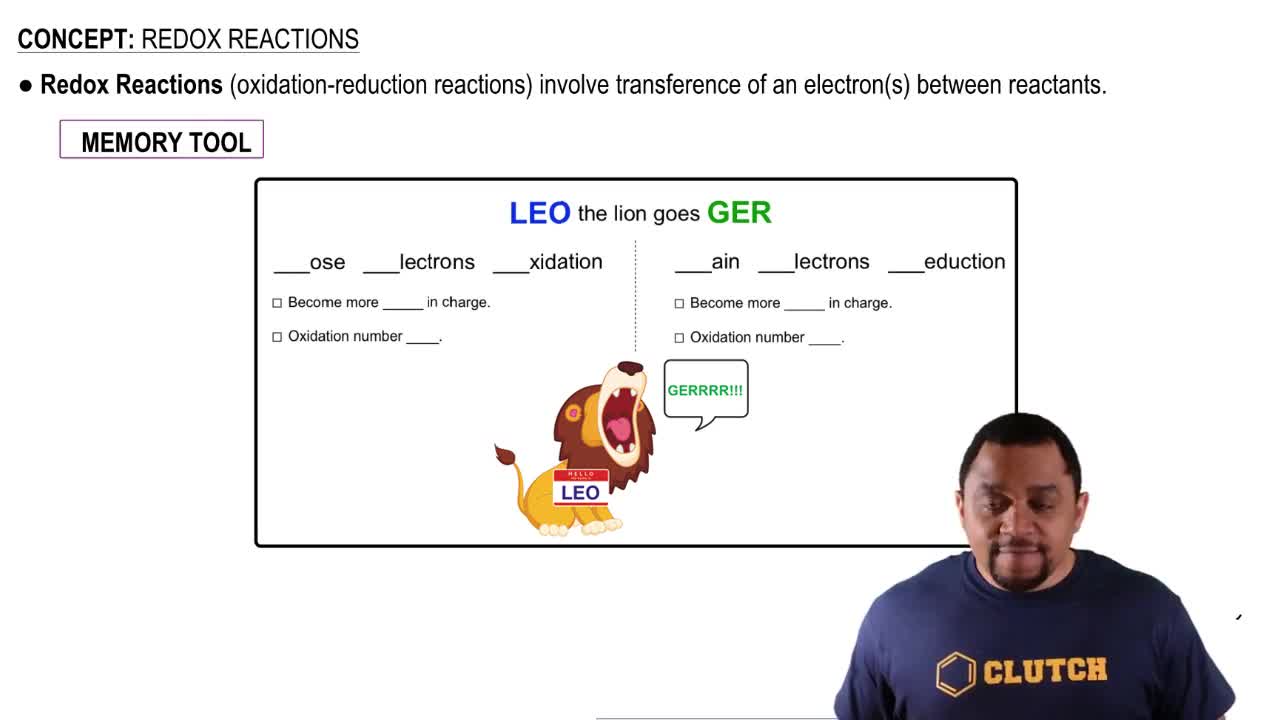
Oxidation-reduction (redox) reactions involve the transfer of electrons between species, leading to changes in oxidation states. In this context, zinc is oxidized (loses electrons) while copper ions are reduced (gain electrons). Understanding the roles of oxidizing and reducing agents is crucial for writing the correct net ionic equation for the reaction.
Recommended video:
Guided course
01:53
Oxidation and Reduction Reactions

Solubility Rules

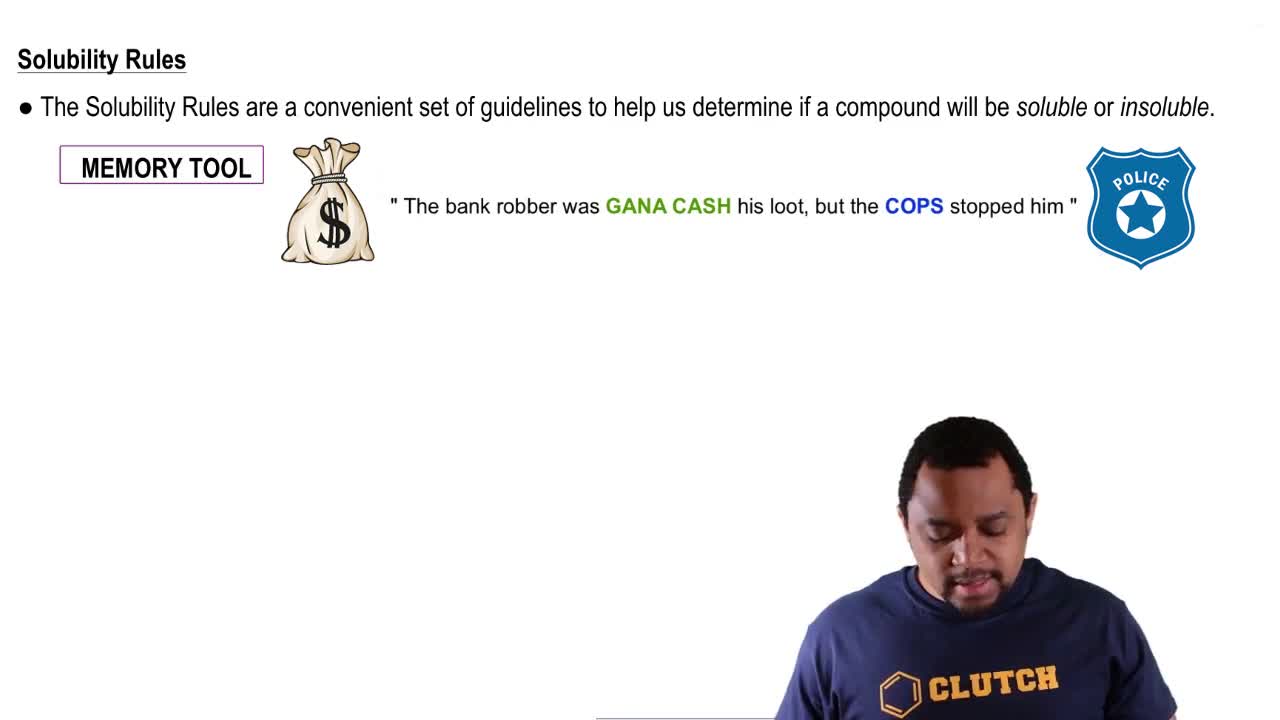
Solubility rules help predict whether a compound will dissolve in water, which is essential for determining the reactants and products in aqueous reactions. For instance, copper(II) nitrate is soluble, while silver may form an insoluble compound with certain anions. Knowing these rules aids in identifying which ions remain in solution and which precipitate out during the reaction.
Recommended video:
Guided course
00:28
Solubility Rules
Related Practice
Textbook Question

(a) By titration, 15.0 mL of 0.1008 M sodium hydroxide is needed to neutralize a 0.2053-g sample of a weak acid. What is the molar mass of the acid if it is monoprotic?

1329
views

Textbook Question
The discovery of hafnium, element number 72, provideda controversial episode in chemistry. G. Urbain, a Frenchchemist, claimed in 1911 to have isolated an elementnumber 72 from a sample of rare earth (elements 58–71)compounds. However, Niels Bohr believed that hafniumwas more likely to be found along with zirconium thanwith the rare earths. D. Coster and G. von Hevesy, workingin Bohr's laboratory in Copenhagen, showed in 1922 thatelement 72 was present in a sample of Norwegian zircon,an ore of zirconium. (The name hafnium comes from theLatin name for Copenhagen, Hafnia). (c) Solid zirconiumdioxide, ZrO2, reacts with chlorine gas in the presenceof carbon. The products of the reaction are ZrCl4 and twogases, CO2 and CO in the ratio 1:2. Write a balanced chemicalequation for the reaction.
655
views
Textbook Question

Citric acid, C6H8O7, is a triprotic acid. It occurs naturally in citrus fruits like lemons and has applications in food flavouring and preservatives. A solution containing an unknown concentration of the acid is titrated with KOH. It requires 23.20 mL of 0.500 M KOH solution to titrate all three acidic protons in 100.00 mL of the citric acid solution. Calculate the molarity of the citric acid solution.

2019
views
Textbook Question

(b) An elemental analysis of the acid indicates that it is composed of 5.89% H, 70.6% C, and 23.5% O by mass. What is its molecular formula?

1437
views
Textbook Question

Suppose you have 3.00 g of powdered zinc metal, 3.00g of powdered silver metal and 500.0 mL of a 0.2 M copper(II) nitrate solution. (a) Which metal will react with the copper(II) nitrate solution?

330
views
Textbook Question
(c) If 18.65 mLof the caesium hydroxide solution was needed to neutralize a42.3 mL aliquot of the hydroiodic acid solution, what is theconcentration (molarity) of the acid?
492
views