Ch.4 - Reactions in Aqueous Solution
Brown - Chemistry: The Central Science 14th Edition
Brown14th EditionChemistry: The Central ScienceISBN: 9780134414232Not the one you use?Change textbook
Chapter 4, Problem 56a

Using the activity series (Table 4.5), write balanced chemical equations for the following reactions. If no reaction occurs, write NR. (a) Nickel metal is added to a solution of copper(II) nitrate

Verified step by step guidance
1
Identify the reactants: Nickel (Ni) metal and copper(II) nitrate (Cu(NO_3)_2) solution.
Write the unbalanced chemical equation for the potential single displacement reaction: Ni(s) + Cu(NO_3)_2(aq) -> Cu(s) + Ni(NO_3)_2(aq).
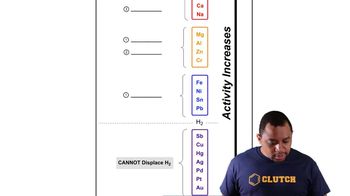
Consult the activity series to determine if nickel can displace copper. Nickel must be higher than copper in the activity series for the reaction to occur.
If nickel is higher than copper in the activity series, balance the chemical equation by ensuring the number of atoms of each element is equal on both sides.
If nickel is not higher than copper in the activity series, write 'NR' to indicate that no reaction occurs.

Verified video answer for a similar problem:

This video solution was recommended by our tutors as helpful for the problem above.
Video duration:
3m
Was this helpful?

Key Concepts

Here are the essential concepts you must grasp in order to answer the question correctly.

Activity Series

The activity series is a list of metals ranked by their ability to displace other metals from solutions of their ions. Metals higher in the series can displace those lower in the series. This concept is crucial for predicting whether a reaction will occur when a metal is added to a solution containing another metal's ions.
Recommended video:
Guided course
02:02
Activity Series Chart

Single Replacement Reaction

A single replacement reaction occurs when one element replaces another in a compound. In the context of the activity series, if a more reactive metal is introduced to a solution containing a less reactive metal's ions, a reaction will take place, resulting in the formation of a new compound and the release of the less reactive metal.

Balancing Chemical Equations

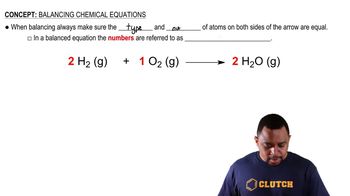
Balancing chemical equations involves ensuring that the number of atoms for each element is the same on both sides of the equation. This is essential for accurately representing the conservation of mass during a chemical reaction. In the case of a reaction or no reaction, the balanced equation reflects the stoichiometry of the reactants and products involved.
Recommended video:
Guided course
01:32
Balancing Chemical Equations
Related Practice
Textbook Question

Using the activity series (Table 4.5), write balanced chemical equations for the following reactions. If no reaction occurs, write NR. (e) aluminum metal is added to a solution of cobalt(II) sulfate.

422
views

Textbook Question

Using the activity series (Table 4.5), write balanced chemical equations for the following reactions. If no reaction occurs, write NR. (d) chromium metal is immersed in an aqueous solution of cobalt(II) chloride

735
views
Textbook Question

The metal cadmium tends to form Cd2+ ions. The following observations are made: (i) When a strip of zinc metal is placed in CdCl2(aq), cadmium metal is deposited on the strip. (ii) When a strip of cadmium metal is placed in Ni(NO3)(aq), nickel metal is deposited on the strip. (a) Write net ionic equations to explain each of the preceding observations.

1
views
Textbook Question

Using the activity series (Table 4.5), write balanced chemical equations for the following reactions. If no reaction occurs, write NR. (a) Iron metal is added to a solution of copper(II) nitrate (b) zinc metal is added to a solution of magnesium sulfate

756
views
Textbook Question

Using the activity series (Table 4.5), write balanced chemical equations for the following reactions. If no reaction occurs, write NR. (e) hydrogen gas is bubbled through a solution of silver nitrate.

583
views
Textbook Question

Using the activity series (Table 4.5), write balanced chemical equations for the following reactions. If no reaction occurs, write NR. (d) hydrogen gas is bubbled through an aqueous solution of nickel(II) chloride

758
views