
For each of the following compounds, write a balanced thermochemical equation depicting the formation of one mole of the compound from its elements in their standard states and then look up ΔH°f for each substance in Appendix C. (a) NO2(g) (b) SO3(g) (c) NaBr(s) (d) Pb(NO3)2(s).
Ch.5 - Thermochemistry
Brown14th EditionChemistry: The Central ScienceISBN: 9780134414232Not the one you use?Change textbook
Chapter 5, Problem 70a
Write balanced equations that describe the formation of the following compounds from elements in their standard states, and then look up the standard enthalpy of formation for each substance in Appendix C: (a) CH3OH(l)
Verified step by step guidance1
Identify the elements in their standard states that make up the compound CH3OH(l), which are carbon (C), hydrogen (H), and oxygen (O). Carbon is in the solid state as graphite, hydrogen is a gas (H2), and oxygen is also a gas (O2).
Write the unbalanced equation using these elements: C(s) + H2(g) + O2(g) → CH3OH(l).
Balance the equation by adjusting the coefficients to ensure the same number of each type of atom on both sides of the equation. The balanced equation should be: 2C(s) + 4H2(g) + O2(g) → 2CH3OH(l).
Check the balanced equation to confirm that the number of atoms for each element is equal on both sides of the equation. For example, there should be 2 carbon atoms, 8 hydrogen atoms, and 2 oxygen atoms on both sides.
Look up the standard enthalpy of formation (ΔHf°) for CH3OH(l) in Appendix C of your chemistry textbook or a reliable chemistry database.

Verified video answer for a similar problem:
This video solution was recommended by our tutors as helpful for the problem above.
Video duration:
4mWas this helpful?
Key Concepts
Here are the essential concepts you must grasp in order to answer the question correctly.
Balanced Chemical Equations
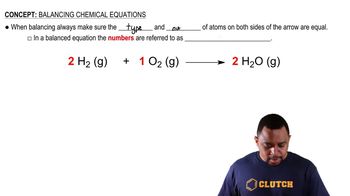
A balanced chemical equation represents a chemical reaction where the number of atoms for each element is the same on both sides of the equation. This is crucial for obeying the law of conservation of mass. To balance an equation, coefficients are adjusted to ensure that the total number of each type of atom is equal, reflecting the stoichiometry of the reaction.
Recommended video:
Guided course
Balancing Chemical Equations
Standard State of Elements
The standard state of an element refers to its most stable form at a specified temperature (usually 25°C) and pressure (1 atm). For example, the standard state of carbon is graphite, and for oxygen, it is O2 gas. Understanding standard states is essential for accurately writing formation reactions, as they provide the baseline conditions under which enthalpy changes are measured.
Standard Enthalpy of Formation
The standard enthalpy of formation (ΔH_f°) is the change in enthalpy when one mole of a compound is formed from its elements in their standard states. This value is crucial for thermodynamic calculations and helps predict the energy changes associated with chemical reactions. It is typically found in tables and is used to calculate the overall enthalpy change for reactions involving the formation of compounds.
Related Practice
Textbook Question
1051
views
Textbook Question
Acetylene (C2H2(g)) is used for welding because oxyacetylene is the hottest burning common fuel gas. Using standard enthalpies of formation, calculate the quantity of heat produced when 10 g of acetylene is completely combusted in air under standard conditions.
589
views
Textbook Question
Given the data N2(g) + O2(g) → 2 NO(g) ΔH = +180.7 kJ 2 NO(g) + O2(g) → 2 NO2(g) ΔH = -113.1 kJ 2 N2O(g) → 2 N2(g) + O2(g) ΔH = -163.2 kJ use Hess's law to calculate ΔH for the reaction N2O(g) + NO2(g) → 3 NO(g)
894
views
Textbook Question
(a) Why does the standard enthalpy of formation of both the very reactive fluorine (F2) and the almost inert gas nitrogen (N2) both read zero?
556
views
