
Two solid objects, A and B, are placed in boiling water and allowed to come to the temperature of the water. Each is then lifted out and placed in separate beakers containing 1000 g of water at 10.0 °C. Object A increases the water temperature by 3.50 °C; B increases the water temperature by 2.60 °C. (b) What can you say about the specific heats of A and B?
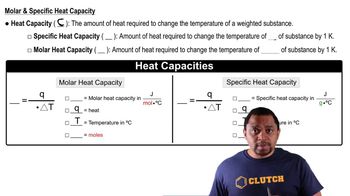
(a) Derive an equation to convert the specific heat of a pure substance to its molar heat capacity. (b) If you know the specific heat of aluminum, what additional information do you need to calculate the heat capacity of a particular piece of an aluminum component?
Verified step by step guidanceKey Concepts
Specific Heat Capacity
Molar Heat Capacity
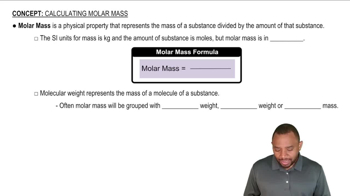
Mass and Molar Mass
Consider the decomposition of liquid benzene, C6H6(l), to gaseous acetylene, C2H2(g): C6H6(l) → 3 C2H2(g) ΔH = +630 kJ (c) Which is more likely to be thermodynamically favored, the forward reaction or the reverse reaction?
Consider the decomposition of liquid benzene, C6H6(l), to gaseous acetylene, C2H2(g): C6H6(l) → 3 C2H2(g) ΔH = +630 kJ (a) What is the enthalpy change for the reverse reaction?
Consider the decomposition of liquid benzene, C6H6(l), to gaseous acetylene, C2H2(g): C6H6(l) → 3 C2H2(g) ΔH = +630 kJ (b) What is H for the formation of 1 mol of acetylene?
Two solid objects, A and B, are placed in boiling water and allowed to come to the temperature of the water. Each is then lifted out and placed in separate beakers containing 1000 g of water at 10.0 °C. Object A increases the water temperature by 3.50 °C; B increases the water temperature by 2.60 °C. (a) Which object has the larger heat capacity?
(b) The specific heat of aluminum is 0.9 J/(g - K). Calculate its molar heat capacity.
