
In a thermodynamic study, a scientist focuses on the properties of a solution in an apparatus as illustrated. A solution is continuously flowing into the apparatus at the top and out at the bottom, such that the amount of solution in the apparatus is constant with time. (b) If the inlet and outlet were closed, what type of system would it be
Ch.5 - Thermochemistry
Brown14th EditionChemistry: The Central ScienceISBN: 9780134414232Not the one you use?Change textbook
Chapter 5, Problem 17
A sodium ion, Na+, with a charge of 1.6⨉10-19 C and a chloride ion, Cl - , with charge of -1.6⨉10-19 C, are separated by a distance of 0.50 nm. How much work would be required to increase the separation of the two ions to an infinite distance?
Verified step by step guidance1
Identify the initial and final states of the system. Initially, the sodium ion (Na^+) and the chloride ion (Cl^-) are separated by a distance of 0.50 nm. The final state is when the ions are separated by an infinite distance.
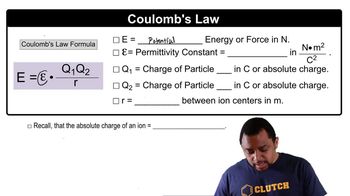
Use the formula for the electrostatic potential energy between two point charges: U = k * (q1 * q2) / r, where k is Coulomb's constant (8.99 x 10^9 N m^2/C^2), q1 and q2 are the charges of the ions, and r is the separation distance.
Calculate the initial potential energy (U_initial) using the given charges (q1 = 1.6 x 10^-19 C, q2 = -1.6 x 10^-19 C) and the initial separation distance (r = 0.50 nm = 0.50 x 10^-9 m).
Determine the final potential energy (U_final) when the ions are separated by an infinite distance. At infinite separation, the potential energy is zero because the interaction between the charges is negligible.
Calculate the work done (W) to separate the ions to an infinite distance using the formula: W = U_final - U_initial. Since U_final is zero, W = -U_initial.

Verified video answer for a similar problem:
This video solution was recommended by our tutors as helpful for the problem above.
Video duration:
5mWas this helpful?
Key Concepts
Here are the essential concepts you must grasp in order to answer the question correctly.
Coulomb's Law
Coulomb's Law describes the electrostatic force between two charged particles. It states that the force is directly proportional to the product of the magnitudes of the charges and inversely proportional to the square of the distance between them. This principle is essential for calculating the work done in moving charged particles, as it provides the foundational relationship between charge, distance, and force.
Recommended video:
Guided course
Coulomb's Law Concept 2
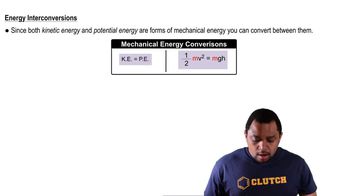
Electric Potential Energy
Electric potential energy is the energy stored in a system of charged particles due to their positions relative to each other. It can be calculated using the formula U = k * (q1 * q2) / r, where U is the potential energy, k is Coulomb's constant, q1 and q2 are the charges, and r is the distance between them. Understanding this concept is crucial for determining the work required to change the separation of charged ions.
Recommended video:
Guided course
Kinetic & Potential Energy
Work-Energy Principle
The work-energy principle states that the work done on an object is equal to the change in its energy. In the context of charged particles, the work required to move them from one position to another can be calculated by finding the difference in electric potential energy at those positions. This principle allows us to quantify the energy needed to separate the sodium and chloride ions to an infinite distance.
Recommended video:
Guided course
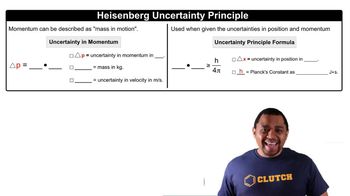
Uncertainty Principle Formula
Related Practice
Textbook Question
333
views
Textbook Question
A magnesium ion, Mg2+, with a charge of 3.2⨉10-19 C and an oxide ion, O2-, with a charge of -3.2⨉10-19 C, are separated by a distance of 0.35 nm. How much work would be required to increase the separation of the two ions to an infinite distance?
1928
views
Textbook Question
(a) The electrostatic force (not energy) of attraction between two oppositely charged objects is given by the equation F = k (Q1Q2/d2) where k = 8.99⨉109N-m2/C2, Q1 and Q2 are the charges of the two objects in Coulombs, and d is the distance separating the two objects in meters. What is the electrostatic force of attraction (in Newtons) between an electron and a proton that are separated by 1⨉102 pm?
1554
views
1
rank
