From the following data for three prospective fuels, calculate which could provide the most energy per unit mass and per unit volume:
Ch.5 - Thermochemistry
Brown14th EditionChemistry: The Central ScienceISBN: 9780134414232Not the one you use?Change textbook
Chapter 5, Problem 109
Burning acetylene in oxygen can produce three different carbon-containing products: soot (very fine particles of graphite), CO(g), and CO2(g). (a) Write three balanced equations for the reaction of acetylene gas with oxygen to produce these three products. In each case assume that H2O(l) is the only other product. Determine the standard enthalpies for the reactions in part (a).
Verified step by step guidance1
Step 1: Write the balanced chemical equation for the complete combustion of acetylene (C2H2) to produce carbon dioxide (CO2) and water (H2O). The general form is: C2H2 + O2 -> CO2 + H2O. Balance the equation by ensuring the number of atoms of each element is equal on both sides.
Step 2: Write the balanced chemical equation for the incomplete combustion of acetylene to produce carbon monoxide (CO) and water (H2O). The general form is: C2H2 + O2 -> CO + H2O. Balance the equation by adjusting the coefficients to ensure the conservation of mass.
Step 3: Write the balanced chemical equation for the combustion of acetylene to produce soot (graphite, C) and water (H2O). The general form is: C2H2 + O2 -> C + H2O. Balance the equation by ensuring the number of carbon, hydrogen, and oxygen atoms are equal on both sides.
Step 4: Determine the standard enthalpy change (ΔH°) for each reaction. Use standard enthalpy of formation values from a data table for each reactant and product. Apply Hess's Law: ΔH° = ΣΔH°f(products) - ΣΔH°f(reactants).
Step 5: Calculate the standard enthalpy change for each reaction using the balanced equations and the standard enthalpy of formation values. This involves substituting the values into the equation from Step 4 and performing the arithmetic to find ΔH° for each reaction.
Key Concepts
Here are the essential concepts you must grasp in order to answer the question correctly.
Combustion Reactions
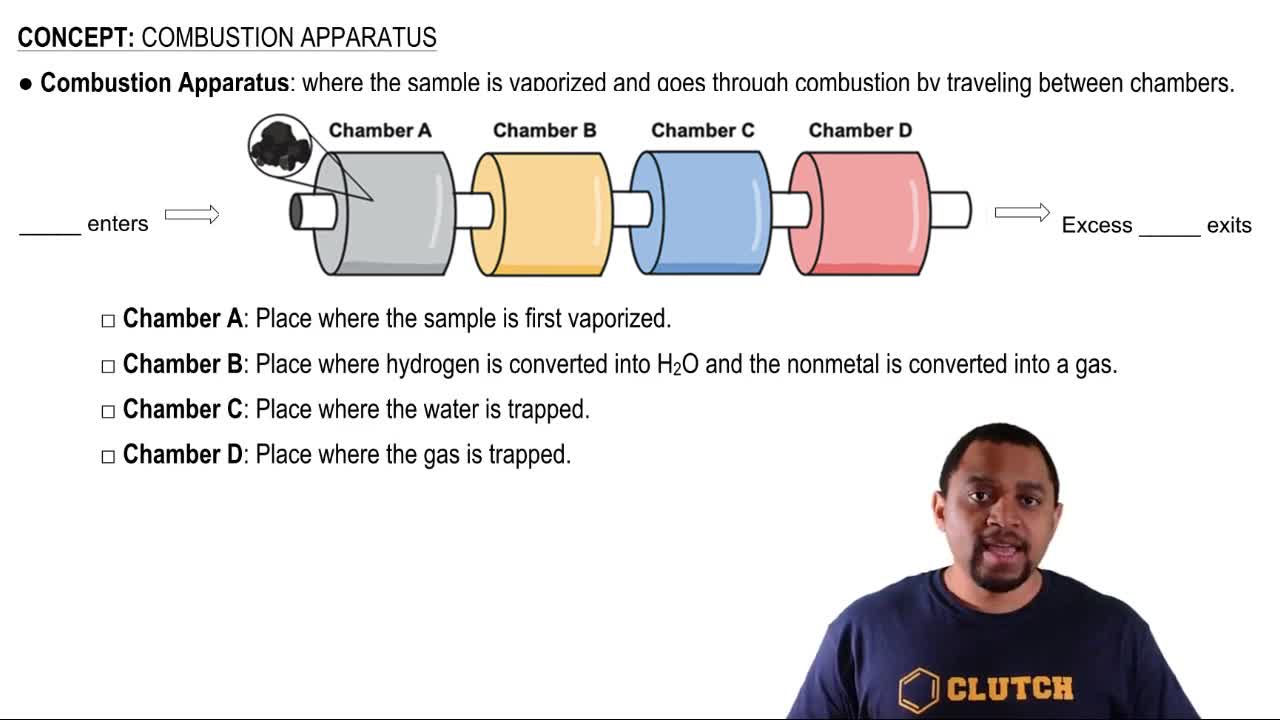
Combustion reactions involve the reaction of a fuel with an oxidant, typically oxygen, resulting in the release of energy. In the case of acetylene (C2H2), it can combust completely to form carbon dioxide (CO2) and water (H2O), or partially to produce carbon monoxide (CO) and soot. Understanding the stoichiometry of these reactions is essential for writing balanced chemical equations.
Recommended video:
Guided course
Combustion Apparatus
Balancing Chemical Equations
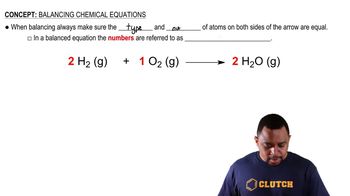
Balancing chemical equations is a fundamental skill in chemistry that ensures the law of conservation of mass is upheld. This involves adjusting the coefficients of reactants and products so that the number of atoms of each element is the same on both sides of the equation. For the combustion of acetylene, this means carefully counting and adjusting the carbon, hydrogen, and oxygen atoms to reflect the products formed.
Recommended video:
Guided course
Balancing Chemical Equations
Standard Enthalpy of Reaction
The standard enthalpy of reaction (ΔH°) is the heat change that occurs when reactants are converted to products under standard conditions (1 atm pressure and 25°C). It is crucial for understanding the energy changes associated with chemical reactions, including combustion. Calculating ΔH° for the combustion of acetylene requires knowledge of the enthalpies of formation for the reactants and products involved.
Related Practice
Textbook Question
569
views
Textbook Question
When magnesium metal is burned in air (Figure 3.6), two products are produced. One is magnesium oxide, MgO. The other is the product of the reaction of Mg with molecular nitrogen, magnesium nitride. When water is added to magnesium nitride, it reacts to form magnesium oxide and ammonia gas. (e) The standard enthalpy of formation of solid magnesium nitride is -461.08 kJ>mol. Calculate the standard enthalpy change for the reaction between magnesium metal and ammonia gas.
2062
views
Textbook Question
A coffee-cup calorimeter of the type shown in Figure 5.18 contains 150.0 g of water at 25.1°C A 121.0-g block of copper metal is heated to 100.4°C by putting it in a beaker of boiling water. The specific heat of Cu(s) is 0.385 J/g-K The Cu is added to the calorimeter, and after a time the contents of the cup reach a constant temperature of 30.1°C (b) Determine the amount of heat gained by the water. The specific heat of water is 4.184 J/1gK.
650
views
1
rank
Textbook Question
(b) Assuming that there is an uncertainty of 0.002 °C in each temperature reading and that the masses of samples are measured to 0.001 g, what is the estimated uncertainty in the value calculated for the heat of combustion per mole of caffeine?
912
views
1
rank