
Ch.5 - Thermochemistry
Brown - Chemistry: The Central Science 14th Edition
Brown14th EditionChemistry: The Central ScienceISBN: 9780134414232Not the one you use?Change textbook
Chapter 5, Problem 76

Calcium carbide (CaC2) reacts with water to form acetylene (C2H2) and Ca(OH)2. From the following enthalpy of reaction data and data in Appendix C, calculate H°f for CaC2(s): CaC2(s) + 2 H2O(l) → Ca(OH2)(s) + C2H2(g) ΔH° = -127.2 kJ

Verified step by step guidance
1
Identify the given chemical reaction: \( \text{CaC}_2(s) + 2 \text{H}_2\text{O}(l) \rightarrow \text{Ca(OH)}_2(s) + \text{C}_2\text{H}_2(g) \) with \( \Delta H^\circ = -127.2 \text{ kJ} \).
Use the formula for the standard enthalpy change of reaction: \( \Delta H^\circ = \sum \Delta H^\circ_f(\text{products}) - \sum \Delta H^\circ_f(\text{reactants}) \).
Look up the standard enthalpy of formation values for \( \text{Ca(OH)}_2(s) \) and \( \text{C}_2\text{H}_2(g) \) in Appendix C.
Set up the equation: \( -127.2 \text{ kJ} = [\Delta H^\circ_f(\text{Ca(OH)}_2) + \Delta H^\circ_f(\text{C}_2\text{H}_2)] - [\Delta H^\circ_f(\text{CaC}_2) + 2 \times \Delta H^\circ_f(\text{H}_2\text{O})] \).
Solve for \( \Delta H^\circ_f(\text{CaC}_2) \) using the known values from Appendix C and the given \( \Delta H^\circ \).

Verified video answer for a similar problem:

This video solution was recommended by our tutors as helpful for the problem above.
Video duration:
5m
Was this helpful?

Key Concepts

Here are the essential concepts you must grasp in order to answer the question correctly.

Enthalpy of Reaction

Enthalpy of reaction, denoted as ΔH, is the heat change associated with a chemical reaction at constant pressure. It indicates whether a reaction is exothermic (releases heat, ΔH < 0) or endothermic (absorbs heat, ΔH > 0). In the given reaction, the negative ΔH value of -127.2 kJ signifies that the reaction releases energy, which is crucial for calculating the standard enthalpy of formation.

Standard Enthalpy of Formation (H°f)

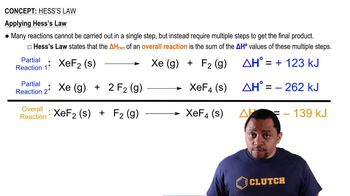
The standard enthalpy of formation (H°f) is the change in enthalpy when one mole of a compound is formed from its elements in their standard states. It is a key concept in thermodynamics and is used to calculate the enthalpy changes in reactions. To find H°f for CaC2(s), one must apply Hess's law, which states that the total enthalpy change for a reaction is the sum of the enthalpy changes for individual steps.

Hess's Law

Hess's Law states that the total enthalpy change for a chemical reaction is the same, regardless of the number of steps or the pathway taken. This principle allows chemists to calculate the enthalpy change of a reaction indirectly by using known enthalpy changes of other reactions. In this case, it can be applied to derive the standard enthalpy of formation for CaC2(s) by combining the enthalpy of the given reaction with the enthalpies of formation of the products and reactants.
Recommended video:
Related Practice