
Textbook Question
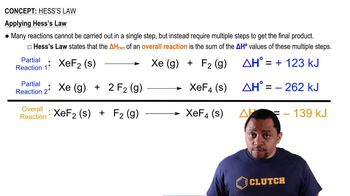
Given the data N2(g) + O2(g) → 2 NO(g) ΔH = +180.7 kJ 2 NO(g) + O2(g) → 2 NO2(g) ΔH = -113.1 kJ 2 N2O(g) → 2 N2(g) + O2(g) ΔH = -163.2 kJ use Hess's law to calculate ΔH for the reaction N2O(g) + NO2(g) → 3 NO(g)
894
views

 Verified step by step guidance
 02:03
02:03
 01:16
01:16Given the data N2(g) + O2(g) → 2 NO(g) ΔH = +180.7 kJ 2 NO(g) + O2(g) → 2 NO2(g) ΔH = -113.1 kJ 2 N2O(g) → 2 N2(g) + O2(g) ΔH = -163.2 kJ use Hess's law to calculate ΔH for the reaction N2O(g) + NO2(g) → 3 NO(g)
(a) Why does the standard enthalpy of formation of both the very reactive fluorine (F2) and the almost inert gas nitrogen (N2) both read zero?
Consider the following hypothetical reactions: A → B ΔHI = +60 kJ B → C ΔHII = -90 kJ (a) Use Hess’s law to calculate the enthalpy change for the reaction A → C.
From the enthalpies of reaction H2(g) + F2(g) → 2 HF(g) ΔH = -537 kJ C(s) + 2 F2(g) → CF4(g) ΔH = -680 kJ 2 C(s) + 2 H2(g) → C2H4(g) ΔH = +52.3 kJ Calculate H for the reaction of ethylene with F2: C2H4(g) + 6 F2(g) → 2 CF4(g) + 4 HF(g)
Under constant-volume conditions, the heat of combustion of naphthalene (C10H8) is 40.18 kJ/g. A 2.50-g sample of naphthalene is burned in a bomb calorimeter. The temperature of the calorimeter increases from 21.50 to 28.83 °C. (c) Suppose that in changing samples, a portion of the water in the calorimeter were lost. In what way, if any, would this change the heat capacity of the calorimeter?
Consider the following hypothetical reactions: A → B ΔHI = +60 kJ B → C ΔHII = -90 kJ (b) Construct an enthalpy diagram for substances A, B, and C, and show how Hess's law applies.