
Textbook Question
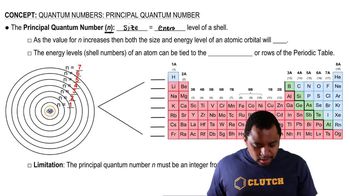
(a) For n = 4, what are the possible values of l?
1164
views

 Verified step by step guidance
 02:55
02:55 02:55
02:55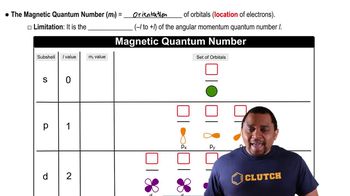 03:06
03:06(a) For n = 4, what are the possible values of l?
A certain orbital of the hydrogen atom has n = 4 and l = 3. (b) What are the possible values of ms for the orbital?
Which of the following represent impossible combinations of n and l? (a) 1p (b) 4s (c) 5f (d) 2d
For the table that follows, write which orbital goes with the quantum numbers. Don't worry about x, y, z subscripts. If the quantum numbers are not allowed, write 'not allowed.' n l ml Orbital 2 1 -1 2p (example) 1 0 0 3 -3 2 3 2 -2 2 0 -1 0 0 0 4 2 1 5 3 0
Using Heisenberg's uncertainty principle, calculate the uncertainty in the position of (b) a proton moving at a speed of 15.00 { 0.012 * 104 m/s. (The mass of a proton is given in the table of fundamental constants in the inside cover of the text.)
Calculate the uncertainty in the position of (a) an electron moving at a speed of 13.00 ± 0.012 × 10⁵ m/s (b) a neutron moving at this same speed. (The masses of an electron and a neutron are given in the table of fundamental constants in the inside cover of the text.)