
Ch.6 - Electronic Structure of Atoms
Brown - Chemistry: The Central Science 14th Edition
Brown14th EditionChemistry: The Central ScienceISBN: 9780134414232Not the one you use?Change textbook
Chapter 6, Problem 2c

A popular kitchen appliance produces electromagnetic radiation with a frequency of 2450 MHz. With reference to Figure 6.4, answer the following: (c) If the radiation is not visible, do photons of this radiation have more or less energy than photons of visible light?
Diagram of the electromagnetic spectrum showing frequency ranges and visible light.

Verified step by step guidance
1
Identify the frequency of the electromagnetic radiation produced by the kitchen appliance, which is 2450 MHz.
Convert the frequency from MHz to Hz by multiplying by \$10^6\( (since 1 MHz = \)10^6$ Hz).
Locate the frequency of 2450 MHz (or \(2.45 \times 10^9\) Hz) on the electromagnetic spectrum diagram provided.
Compare the position of 2450 MHz on the spectrum with the visible light range (approximately \(4 \times 10^{14}\) Hz to \(7.5 \times 10^{14}\) Hz).
Conclude whether the energy of the photons of this radiation is more or less than that of visible light photons by using the relationship \(E = h \nu\), where \(E\) is energy, \(h\) is Planck's constant, and \(\nu\) is frequency.

Verified video answer for a similar problem:

This video solution was recommended by our tutors as helpful for the problem above.
Video duration:
2m
Was this helpful?

Key Concepts

Here are the essential concepts you must grasp in order to answer the question correctly.

Electromagnetic Spectrum

The electromagnetic spectrum encompasses all types of electromagnetic radiation, arranged by frequency or wavelength. It ranges from low-frequency radio waves to high-frequency gamma rays. Visible light, which is the portion of the spectrum detectable by the human eye, occupies a small range between approximately 400 nm (violet) and 700 nm (red). Understanding where different types of radiation fall within this spectrum is crucial for comparing their properties.

Photon Energy

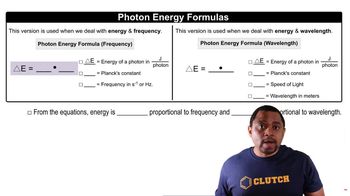
Photons are particles of light that carry energy, which is directly proportional to their frequency and inversely proportional to their wavelength. The energy of a photon can be calculated using the equation E = hν, where E is energy, h is Planck's constant, and ν is frequency. Therefore, higher frequency radiation, such as ultraviolet light, has more energy per photon than lower frequency radiation, such as microwaves.
Recommended video:
Guided course
01:40
Photon Energy Formulas

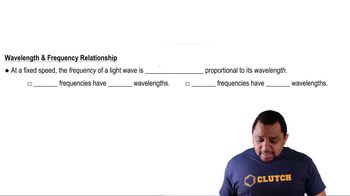
Frequency and Energy Relationship

The relationship between frequency and energy is fundamental in understanding electromagnetic radiation. As frequency increases, the energy of the photons also increases. For example, the frequency of 2450 MHz (microwave radiation) is lower than that of visible light, which ranges from about 430 THz to 750 THz. Consequently, photons of microwave radiation have less energy than those of visible light, despite being invisible to the human eye.
Recommended video:
Guided course
00:31
Frequency-Wavelength Relationship