Ch.6 - Electronic Structure of Atoms
Brown - Chemistry: The Central Science 14th Edition
Brown14th EditionChemistry: The Central ScienceISBN: 9780134414232Not the one you use?Change textbook
Chapter 6, Problem 39a

(a) Using Equation 6.5, calculate the energy of an electron in the hydrogen atom when n = 3 and when n = 6. Calculate the wavelength of the radiation released when an electron moves from n = 6 to n = 3.

Verified step by step guidance
1
Identify the equation for the energy of an electron in a hydrogen atom, which is typically given by the formula: E_n = -\(\frac{Z^2 \times 13.6 \text{ eV}\)}{n^2}, where Z is the atomic number (1 for hydrogen) and n is the principal quantum number.
Substitute n = 3 into the energy equation to find the energy of the electron when n = 3.
Substitute n = 6 into the energy equation to find the energy of the electron when n = 6.
Calculate the energy difference (\(\Delta\) E) between the two energy levels (n = 6 and n = 3) by subtracting the energy at n = 3 from the energy at n = 6.
Use the energy difference calculated in the previous step to find the wavelength of the radiation released using the formula: \(\lambda\) = \(\frac{hc}{\Delta E}\), where h is Planck's constant (6.626 x 10^{-34} J s) and c is the speed of light (3.00 x 10^8 m/s).

Verified video answer for a similar problem:

This video solution was recommended by our tutors as helpful for the problem above.
Video duration:
3m
Was this helpful?

Key Concepts

Here are the essential concepts you must grasp in order to answer the question correctly.

Energy Levels in Hydrogen Atom

In a hydrogen atom, electrons occupy discrete energy levels, denoted by the principal quantum number 'n'. The energy of an electron in a given level can be calculated using the formula E_n = -13.6 eV/n², where E_n is the energy in electron volts and n is the principal quantum number. Higher values of n correspond to higher energy levels, and the energy becomes less negative as n increases.

Photon Emission and Wavelength

When an electron transitions between energy levels, it can emit or absorb a photon, which corresponds to the energy difference between the two levels. The energy of the emitted photon can be calculated using the equation ΔE = E_initial - E_final. The wavelength of the emitted radiation can then be determined using the equation λ = hc/ΔE, where h is Planck's constant and c is the speed of light.
Recommended video:
Guided course
01:51
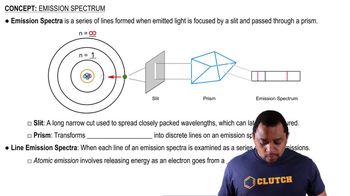
Emission Spectra

Calculating Energy Differences

To find the energy difference when an electron moves from a higher energy level (n=6) to a lower one (n=3), you first calculate the energies at both levels using the energy formula. The difference in energy (ΔE) will give you the energy of the photon emitted during the transition. This energy can then be used to find the wavelength of the emitted radiation, which is crucial for understanding the spectral lines of hydrogen.
Recommended video:
Guided course
01:51
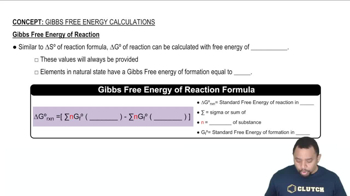
Gibbs Free Energy of Reactions
Related Practice
Textbook Question

Is energy emitted or absorbed when the following electronic transitions occur in hydrogen? (a) from n = 3 to n = 2 (c) an electron adds to the H+ ion and ends up in the n = 2 shell?

734
views

Textbook Question

Classify each of the following statements as either true or false: (a) A hydrogen atom in the n = 3 state can emit light at only two specific wavelengths (b) a hydrogen atom in the n = 2 state is at a lower energy than one in the n = 1 state (c) the energy of an emitted photon equals the energy difference of the two states involved in the emission.

663
views
Textbook Question

(b) Is this line in the visible region of the electromagnetic spectrum?

1
views
Textbook Question

The visible emission lines observed by Balmer all involved nf = 2. (a) Which of the following is the best explanation of why the lines with nf = 3 are not observed in the visible portion of the spectrum: (i) Transitions to nf = 3 are not allowed to happen, (ii) transitions to nf = 3 emit photons in the infrared portion of the spectrum, (iii) transitions to nf = 3 emit photons in the ultraviolet portion of the spectrum, or (iv) transitions to nf = 3 emit photons that are at exactly the same wavelengths as those to nf = 2.

1104
views
Textbook Question

Indicate whether energy is emitted or absorbed when the following electronic transitions occur in hydrogen: (a) from n = 2 to n = 3 (c) from the n = 9 to the n = 6 state.

752
views
Textbook Question

Consider a transition of the electron in the hydrogen atom from n = 8 to n = 3. (b) Will the light be absorbed or emitted?

1347
views