
If human height were quantized in 1-cm increments, what would happen to the height of a child as she grows up: (i) the child's height would never change, (ii) the child's height would continuously increase, (iii) the child's height would increase in jumps of 6 cm, or (iv) the child's height would increase in 'jumps' of 1 cm at a time?
Ch.6 - Electronic Structure of Atoms
Brown14th EditionChemistry: The Central ScienceISBN: 9780134414232Not the one you use?Change textbook
Chapter 6, Problem 25b
(b) Calculate the energy of a photon of radiation whose wavelength is 413 nm.
Verified step by step guidance1
Convert the wavelength from nanometers to meters by using the conversion factor: 1 nm = 1 x 10^{-9} m.
Use the speed of light equation: c = \(\lambda\) \(\nu\), where c is the speed of light (3.00 x 10^8 m/s), \(\lambda\) is the wavelength in meters, and \(\nu\) is the frequency in s^{-1}. Rearrange the equation to solve for frequency: \(\nu\) = \(\frac{c}{\lambda}\).
Substitute the wavelength in meters into the equation to calculate the frequency.
Use Planck's equation to find the energy of the photon: E = h\(\nu\), where E is the energy in joules, h is Planck's constant (6.626 x 10^{-34} J·s), and \(\nu\) is the frequency calculated in the previous step.
Substitute the frequency and Planck's constant into the equation to calculate the energy of the photon.

Verified video answer for a similar problem:
This video solution was recommended by our tutors as helpful for the problem above.
Video duration:
7mWas this helpful?
Key Concepts
Here are the essential concepts you must grasp in order to answer the question correctly.
Photon Energy
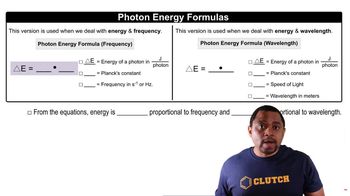
The energy of a photon is directly related to its frequency and inversely related to its wavelength. It can be calculated using the equation E = hν, where E is energy, h is Planck's constant (6.626 x 10^-34 J·s), and ν (nu) is the frequency of the radiation. The frequency can be derived from the wavelength using the speed of light equation, c = λν.
Recommended video:
Guided course
Photon Energy Formulas
Wavelength and Frequency Relationship
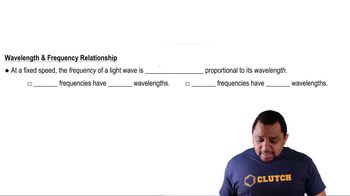
Wavelength (λ) and frequency (ν) are inversely related through the speed of light (c), which is approximately 3.00 x 10^8 m/s. The relationship is expressed as c = λν, meaning that as the wavelength increases, the frequency decreases, and vice versa. This relationship is crucial for converting wavelength measurements into frequency for energy calculations.
Recommended video:
Guided course
Frequency-Wavelength Relationship
Planck's Constant
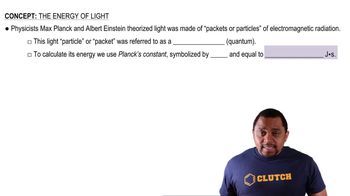
Planck's constant is a fundamental constant in quantum mechanics that relates the energy of a photon to its frequency. It has a value of approximately 6.626 x 10^-34 J·s. This constant is essential for calculating photon energy and highlights the quantized nature of electromagnetic radiation, where energy is emitted or absorbed in discrete packets called quanta.
Recommended video:
Guided course
Photons and Planck's Constant
Related Practice
Textbook Question
463
views
Textbook Question
(a) Calculate the energy of a photon of electromagnetic radiation whose frequency is 2.94 × 10¹⁴ s-1.
834
views
Textbook Question
A laser pointer used in a lecture hall emits light at 650 nm. Using Figure 6.4, predict the color associated with this wavelength.
753
views
Textbook Question
(c) What wavelength of radiation has photons of energy 6.06 × 10⁻¹⁹ J?
Textbook Question
(c) The laser pointer emits light because electrons in the material are excited (by a battery) from their ground state to an upper excited state. When the electrons return to the ground state, they lose the excess energy in the form of 532-nm photons. What is the energy gap between the ground state and excited state in the laser material?
2515
views
1
rank
