
Determine whether each of the following sets of quantum numbers for the hydrogen atom are valid. If a set is not valid, indicate which of the quantum numbers has a value that is not valid: (a) n = 3, l = 3, ml = 2, ms = +1/2 (b) n = 4, l = 3, ml = -3, ms = +1/2 (c) n = 3, l = 1, ml = 2, ms = +1/2 (d) n = 5, l = 0, ml = 0, ms = 0 (e) n = 2, l = 1, ml = 1, ms = -1/2
Ch.6 - Electronic Structure of Atoms
Brown14th EditionChemistry: The Central ScienceISBN: 9780134414232Not the one you use?Change textbook
Chapter 6, Problem 94a
Bohr's model can be used for hydrogen-like ions—ions that have only one electron, such as He+ and Li2+. (a) Why is the Bohr model applicable to He+ ions but not to neutral He atoms?
Verified step by step guidance1
Understand the Bohr model: The Bohr model is specifically designed for systems where a single electron orbits a nucleus. It simplifies the electron-nucleus interaction by considering only one electron moving in a fixed orbit around the nucleus.
Recognize the electron configuration of He+ and neutral He: Helium (He) in its neutral state has two electrons. When it loses one electron, becoming He+, it has only one electron remaining.
Consider electron-electron interaction: In neutral helium, the presence of two electrons means that electron-electron repulsion must be considered, which complicates the system beyond what the Bohr model can accurately handle.
Apply the Bohr model to He+: Since He+ has only one electron, the system is simplified to a single electron orbiting the nucleus, similar to the hydrogen atom. This fits the conditions under which the Bohr model provides a good approximation.
Conclude why Bohr model is not applicable to neutral He: The Bohr model does not account for interactions between multiple electrons, which is necessary for accurately describing the behavior of neutral helium with its two electrons.
Key Concepts
Here are the essential concepts you must grasp in order to answer the question correctly.
Bohr's Model of the Atom
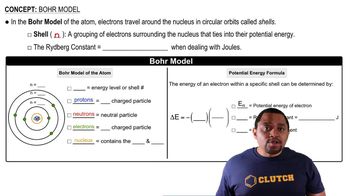
Bohr's model describes the atom as a small, positively charged nucleus surrounded by electrons that travel in circular orbits. It quantizes the angular momentum of electrons, allowing only certain stable orbits. This model is particularly effective for hydrogen-like ions, where a single electron is influenced by the nucleus's charge.
Recommended video:
Guided course
Bohr Model of the Atom
Hydrogen-like Ions
Hydrogen-like ions are ions that contain only one electron, similar to hydrogen. Examples include He<sup>+</sup> and Li<sup>2+</sup>. The simplicity of having a single electron allows for the application of Bohr's model, as the electron's behavior can be accurately predicted by the model's equations, unlike in multi-electron systems.
Electron-Electron Interactions
In neutral helium (He), there are two electrons that repel each other due to their negative charges. This electron-electron interaction complicates the energy levels and orbital shapes, making the Bohr model inadequate. The model does not account for these interactions, which are significant in multi-electron atoms, leading to deviations from the predictions made for hydrogen-like ions.
Related Practice
Textbook Question
1456
views
Textbook Question
The series of emission lines of the hydrogen atom for which nf = 3 is called the Paschen series. (b) Calculate the wavelengths of the first three lines in the Paschen series—those for which ni = 4, 5, and 6.
710
views
Textbook Question
The series of emission lines of the hydrogen atom for which nf = 3 is called the Paschen series. (a) Determine the region of the electromagnetic spectrum in which the lines of the Paschen series are observed.
759
views
