
If human height were quantized in 1-cm increments, what would happen to the height of a child as she grows up: (i) the child's height would never change, (ii) the child's height would continuously increase, (iii) the child's height would increase in jumps of 6 cm, or (iv) the child's height would increase in 'jumps' of 1 cm at a time?
Ch.6 - Electronic Structure of Atoms
Brown14th EditionChemistry: The Central ScienceISBN: 9780134414232Not the one you use?Change textbook
Chapter 6, Problem 20d
(d) What distance does electromagnetic radiation travel in 0.38 ps?
Verified step by step guidance1
Step 1: Understand that the speed of light (c) is the speed at which all electromagnetic radiation travels. The speed of light is a constant, approximately 3.00 x 10^8 meters per second (m/s).
Step 2: Convert the time from picoseconds (ps) to seconds (s) since the speed of light is in meters per second. 1 picosecond is equal to 1 x 10^-12 seconds.
Step 3: Use the formula for distance in physics, which is distance = speed x time. In this case, the speed is the speed of light (c) and the time is the time given in the problem, but converted to seconds.
Step 4: Substitute the values into the formula. The speed of light (c) is 3.00 x 10^8 m/s and the time is the given time in seconds.
Step 5: Calculate the distance by multiplying the speed of light by the time. This will give you the distance the electromagnetic radiation travels in the given time.

Verified video answer for a similar problem:
This video solution was recommended by our tutors as helpful for the problem above.
Video duration:
1mWas this helpful?
Key Concepts
Here are the essential concepts you must grasp in order to answer the question correctly.
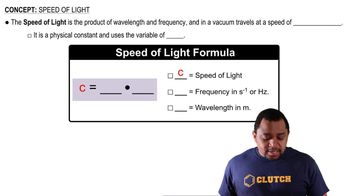
Speed of Light
The speed of light in a vacuum is approximately 3.00 x 10^8 meters per second (m/s). This constant speed is fundamental in understanding how electromagnetic radiation propagates through space. When calculating the distance traveled by light over a specific time interval, this speed is used as the basis for the calculation.
Recommended video:
Guided course
Speed of Light Formula
Time Conversion
In this context, time is given in picoseconds (ps), where 1 picosecond equals 10^-12 seconds. Understanding how to convert time units is essential for accurately calculating distances in physics. For example, to find the distance light travels in 0.38 ps, one must first convert this time into seconds before applying the speed of light.
Recommended video:
Guided course
Conversion Factors
Distance Calculation
Distance traveled by electromagnetic radiation can be calculated using the formula: distance = speed × time. By substituting the speed of light and the converted time into this equation, one can determine how far light travels in the specified time interval. This concept is crucial for solving problems related to wave propagation and electromagnetic theory.
Recommended video:
Guided course
Stoichiometric Rate Calculations
Related Practice
Textbook Question
463
views
Textbook Question
A laser pointer used in a lecture hall emits light at 650 nm. What is the frequency of this radiation?
806
views
Textbook Question
(b) What is the wavelength of radiation that has a frequency of 5.50 × 10¹⁴ s-1?
Textbook Question
A laser pointer used in a lecture hall emits light at 650 nm. Using Figure 6.4, predict the color associated with this wavelength.
753
views
Textbook Question
(a) What is the frequency of radiation that has a wavelength of 10 µm, about the size of a bacterium?
787
views
Textbook Question
(c) Would the radiations in part (a) or part (b) be detected by an X-ray detector?
