
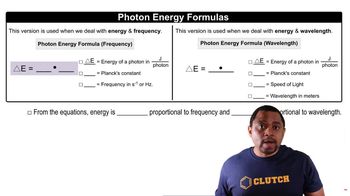

A stellar object is emitting radiation at 3.0 mm. (a) What type of electromagnetic spectrum is this radiation (b) If a detector is capturing 3.0 3 108 photons per second at this wavelength, what is the total energy of the photons detected in 1 day?
One type of sunburn occurs on exposure to UV light of wavelength in the vicinity of 325 nm. (d) These UV photons can break chemical bonds in your skin to cause sunburn—a form of radiation damage. If the 325-nm radiation provides exactly the energy to break an average chemical bond in the skin, estimate the average energy of these bonds in kJ/mol.
Verified step by step guidance
Verified video answer for a similar problem:
Key Concepts
Photon Energy
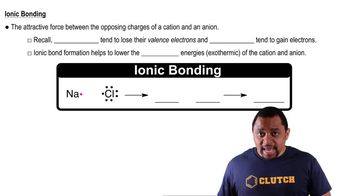
Chemical Bond Energy
Conversion of Energy Units
One type of sunburn occurs on exposure to UV light of wavelength in the vicinity of 325 nm. (a) What is the energy of a photon of this wavelength?
One type of sunburn occurs on exposure to UV light of wavelength in the vicinity of 325 nm. (b) What is the energy of a mole of these photons?
Molybdenum metal must absorb radiation with an energy higher than 7.22 * 10-19 J ('energy threshold') before it can eject an electron from its surface via the photoelectric effect. (a) What is the frequency threshold for emission of electrons?
One type of sunburn occurs on exposure to UV light of wavelength in the vicinity of 325 nm. (c) How many photons are in a 1.00 mJ burst of this radiation?
A diode laser emits at a wavelength of 987 nm. (a) In what portion of the electromagnetic spectrum is this radiation found? (b) All of its output energy is absorbed in a detector that measures a total energy of 0.52 J over a period of 32 s. How many photons per second are being emitted by the laser?
