
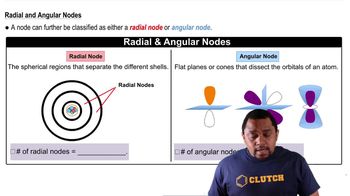
Determine whether each of the following sets of quantum numbers for the hydrogen atom are valid. If a set is not valid, indicate which of the quantum numbers has a value that is not valid: (a) n = 3, l = 3, ml = 2, ms = +1/2 (b) n = 4, l = 3, ml = -3, ms = +1/2 (c) n = 3, l = 1, ml = 2, ms = +1/2 (d) n = 5, l = 0, ml = 0, ms = 0 (e) n = 2, l = 1, ml = 1, ms = -1/2
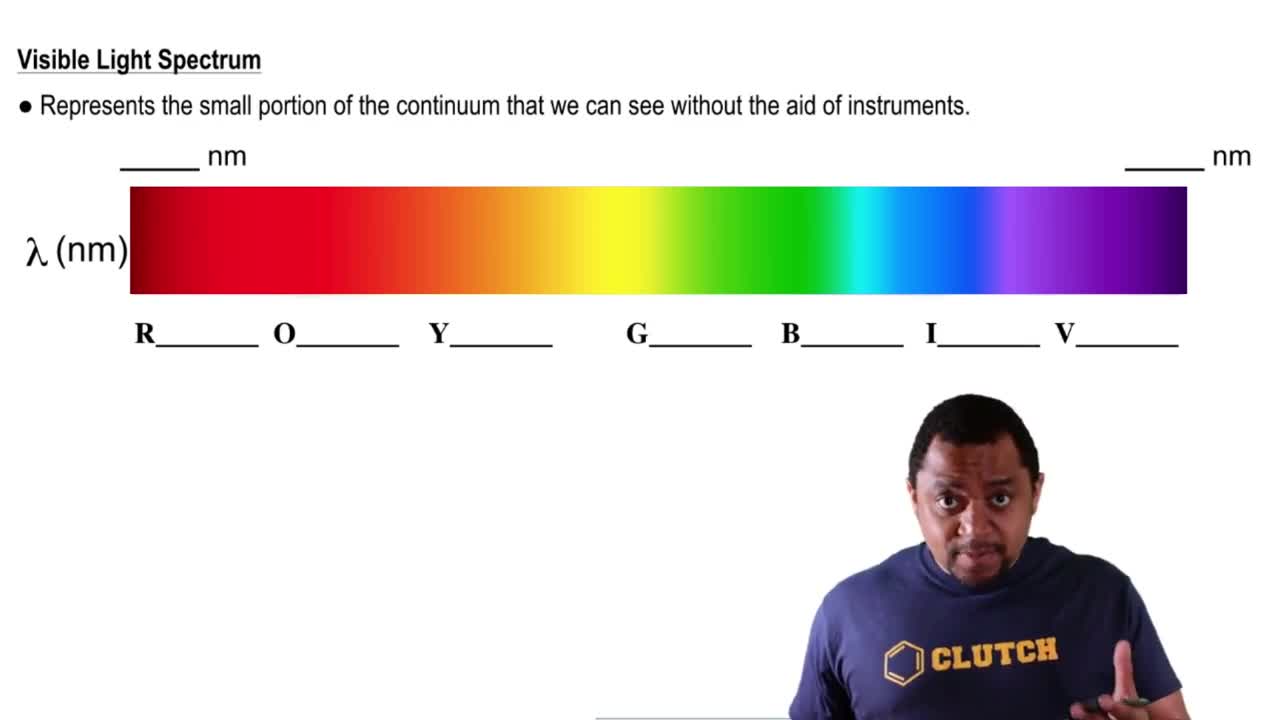
The human retina has three types of receptor cones, each sensitive to a different range of wavelengths of visible light, as shown in this figure (the colors are merely to differentiate the three curves from one another; they do not indicate the actual colors represented by each curve):

(c) Explain why the sky appears blue even though all wavelengths of solar light are scattered by the atmosphere.
Verified step by step guidanceKey Concepts
Visible Light Spectrum
Rayleigh Scattering
Cone Photoreceptors
In an experiment to study the photoelectric effect, a scientist measures the kinetic energy of ejected electrons as a function of the frequency of radiation hitting a metal surface. She obtains the following plot. The point labeled 'n0' corresponds to light with a wavelength of 542 nm. (a) What is the value of n0 in s - 1?
The series of emission lines of the hydrogen atom for which nf = 3 is called the Paschen series. (b) Calculate the wavelengths of the first three lines in the Paschen series—those for which ni = 4, 5, and 6.
Consider a transition in which the electron of a hydrogen atom is excited from n = 1 to n = ∞. (a) What is the end result of this transition?
The series of emission lines of the hydrogen atom for which nf = 3 is called the Paschen series. (a) Determine the region of the electromagnetic spectrum in which the lines of the Paschen series are observed.
Consider a transition in which the electron of a hydrogen atom is excited from n = 1 to n = ∞. (b) What is the wavelength of light that must be absorbed to accomplish this process?
