
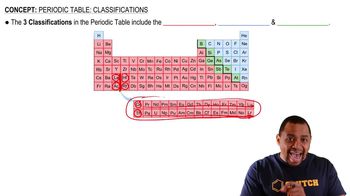
The two most common isotopes of uranium are 235U and 238U. (d) 238U undergoes radioactive decay to 234Th. How many protons, electrons, and neutrons are gained or lost by the 238U atom during this process? (e) Examine the electron configuration for Th in Figure 6.31. Are you surprised by what you find? Explain.
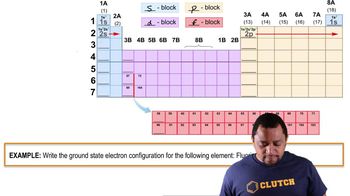
The two most common isotopes of uranium are 235U and 238U. (b) Using the periodic table in the frontinside cover, write the electron configuration for a U atom.
Verified step by step guidance
Verified video answer for a similar problem:
Key Concepts
Electron Configuration
Periodic Table
Uranium Isotopes
The discovery of hafnium, element number 72, provided a controversial episode in chemistry. G. Urbain, a French chemist, claimed in 1911 to have isolated an element number 72 from a sample of rare earth (elements 58–71) compounds. However, Niels Bohr believed that hafnium was more likely to be found along with zirconium than with the rare earths. D. Coster and G. von Hevesy, working in Bohr’s laboratory in Copenhagen, showed in 1922 that element 72 was present in a sample of Norwegian zircon, an ore of zirconium. (The name hafnium comes from the Latin name for Copenhagen, Hafnia). (c) Solid zirconium dioxide, ZrO2, reacts with chlorine gas in the presence of carbon. Starting with a 55.4-g sample of ZrO2, calculate the mass of ZrCl4 formed, assuming that ZrO2 is the limiting reagent and assuming 100% yield.
The discovery of hafnium, element number 72, provided a controversial episode in chemistry. G. Urbain, a French chemist, claimed in 1911 to have isolated an element number 72 from a sample of rare earth (elements 58–71) compounds. However, Niels Bohr believed that hafnium was more likely to be found along with zirconium than with the rare earths. D. Coster and G. von Hevesy, working in Bohr's laboratory in Copenhagen, showed in 1922 that element 72 was present in a sample of Norwegian zircon, an ore of zirconium. (The name hafnium comes from the Latin name for Copenhagen, Hafnia). (d) Using their electron configurations, account for the fact that Zr and Hf form chlorides MCl4 and oxides MO2.
