
Ch.6 - Electronic Structure of Atoms
Brown - Chemistry: The Central Science 14th Edition
Brown14th EditionChemistry: The Central ScienceISBN: 9780134414232Not the one you use?Change textbook
Chapter 6, Problem 102

Using the periodic table as a guide, write the condensed electron configuration and determine the number of unpaired electrons for the ground state of (a) Cl (b) Al (c) Zr (d) As (e) Sb (f) W.

Verified step by step guidance
1
Identify the atomic number of Arsenic (As) from the periodic table, which tells you the number of protons and, in a neutral atom, the number of electrons.
Write out the full electron configuration of As. Start from Hydrogen and follow the order of filling the orbitals: 1s, 2s, 2p, 3s, 3p, 4s, 3d, 4p, etc., until all the electrons are accounted for.
Convert the full electron configuration into the condensed form by using the nearest noble gas preceding As in the periodic table to abbreviate the configuration. This noble gas will represent the electron configuration of all the filled orbitals up to that point.
Examine the electron configuration focusing on the outermost orbitals (valence electrons) to determine the number of unpaired electrons. Remember that unpaired electrons are those that are alone in an orbital, not paired with another electron.
Use Hund's Rule, which states that electrons will fill an empty orbital before they pair up with another electron, to help determine the number of unpaired electrons in the p-orbital or any partially filled orbitals.

Verified video answer for a similar problem:

This video solution was recommended by our tutors as helpful for the problem above.
Video duration:
4m
Was this helpful?

Key Concepts

Here are the essential concepts you must grasp in order to answer the question correctly.

Electron Configuration

Electron configuration describes the distribution of electrons in an atom's orbitals. It is represented using a notation that indicates the energy levels and sublevels occupied by electrons. For example, the condensed electron configuration uses the nearest noble gas to simplify the representation, focusing on the valence electrons that determine chemical properties.
Recommended video:
Guided course
01:33
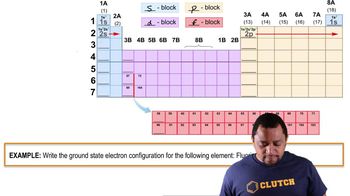
Electron Configuration Example

Ground State

The ground state of an atom refers to the lowest energy configuration of its electrons, where they occupy the lowest available energy levels. In this state, electrons fill orbitals according to the Aufbau principle, Hund's rule, and the Pauli exclusion principle, ensuring that the atom is in its most stable form.
Recommended video:
Guided course
01:32
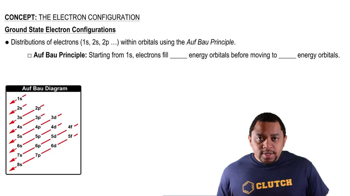
Ground State Electron Configurations

Unpaired Electrons

Unpaired electrons are those that occupy an orbital alone, without a partner of opposite spin. The number of unpaired electrons is significant because it influences an atom's magnetic properties and its ability to form bonds. In the context of the periodic table, elements with unpaired electrons are often more reactive and can participate in chemical reactions more readily.