
Ch.7 - Periodic Properties of the Elements
Brown - Chemistry: The Central Science 14th Edition
Brown14th EditionChemistry: The Central ScienceISBN: 9780134414232Not the one you use?Change textbook
Chapter 7, Problem 9

(a) Evaluate the expressions 2 * 1, 2 * 11 + 32, 2 * 11 + 3 + 52, and 2 * 11 + 3 + 5 + 72. How do the atomic numbers of the noble gases relate to the numbers? (b) What topic discussed in Chapter 6 is the source of the number '2' in the expressions in part (a)?

Verified step by step guidance
1
Step 1: Evaluate the expression 2 * 1. This involves multiplying 2 by 1.
Step 2: Evaluate the expression 2 * 11 + 32. First, multiply 2 by 11, then add 32 to the result.
Step 3: Evaluate the expression 2 * 11 + 3 + 52. Start by multiplying 2 by 11, then add 3, and finally add 52 to the result.
Step 4: Evaluate the expression 2 * 11 + 3 + 5 + 72. Begin by multiplying 2 by 11, then add 3, add 5, and finally add 72 to the result.
Step 5: Relate the results to the atomic numbers of noble gases. Compare the evaluated results with the atomic numbers of noble gases: Helium (2), Neon (10), Argon (18), Krypton (36), Xenon (54), and Radon (86). Consider how these numbers might relate to the evaluated expressions.

Key Concepts

Here are the essential concepts you must grasp in order to answer the question correctly.

Atomic Numbers

Atomic numbers represent the number of protons in an atom's nucleus and define the identity of an element. In the context of noble gases, their atomic numbers are significant as they correspond to the elements in the periodic table, such as Helium (2), Neon (10), Argon (18), Krypton (36), Xenon (54), and Radon (86). Understanding these numbers helps in relating the expressions to the properties of noble gases.
Recommended video:
Guided course
02:10
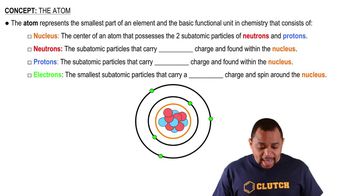
Atom Structure

Noble Gases

Noble gases are a group of elements in Group 18 of the periodic table, known for their lack of reactivity due to having a full valence shell of electrons. This stability is reflected in their atomic numbers, which increase sequentially. The relationship between the expressions and noble gases lies in the patterns of these atomic numbers, which can be derived from the calculations in the question.
Recommended video:
Guided course
00:44
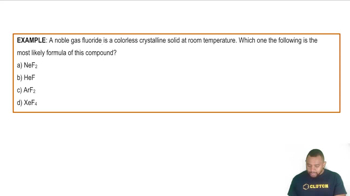
Noble Gas Compounds Example

Chapter 6 Topics

Chapter 6 of general chemistry often covers topics related to the periodic table, including trends in atomic structure and properties. The number '2' in the expressions likely refers to the concept of electron configuration or the octet rule, which explains how elements achieve stability. This foundational knowledge is crucial for understanding the significance of atomic numbers and their relation to noble gases.