
Some ions do not have a corresponding neutral atom that has the same electron configuration. For each of the following ions, identify the neutral atom that has the same number of electrons and determine if this atom has the same electron configuration. (a) CI−, (b) Sc3+, (c) Fe2+, (d) Zn2+, (e) Sn4+.
Consider the isoelectronic ions Cl- and K+. (b) Using Equation 7.1 and assuming that core electrons contribute 1.00 and valence electrons contribute nothing to the screening constant, S, calculate Zeff for these two ions. (c) Repeat this calculation using Slater’s rules to estimate the screening constant, S.
Verified step by step guidanceKey Concepts
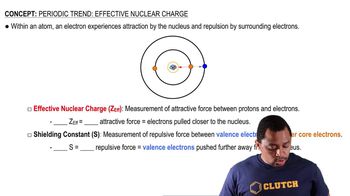
Effective Nuclear Charge (Zeff)
Screening Constant (S)
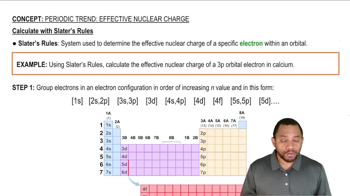
Slater's Rules
Consider S, Cl, and K and their most common ions. (a) List the atoms in order of increasing size.
Consider the isoelectronic ions F- and Na+. (b) Using Equation 7.1 and assuming that core electrons contribute 1.00 and valence electrons contribute 0.00 to the screening constant, S, calculate Zeff for the 2p electrons in both ions.
Consider S, Cl, and K and their most common ions. (b) List the ions in order of increasing size. (c) Explain any differences in the orders of the atomic and ionic sizes.
Consider the isoelectronic ions F- and Na+. (c) Repeat this calculation using Slater’s rules to estimate the screening constant, S.
In the ionic compounds LiF, NaCl, KBr, and RbI, the measured cation–anion distances are 201 pm (Li–F), 282 pm (Na–Cl), 330 pm (K–Br), and 367 pm (Rb–I), respectively. (b) Calculate the difference between the experimentally measured ion–ion distances and the ones predicted from Figure 7.8.
