
Ch.7 - Periodic Properties of the Elements
Brown - Chemistry: The Central Science 14th Edition
Brown14th EditionChemistry: The Central ScienceISBN: 9780134414232Not the one you use?Change textbook
Chapter 7, Problem 114

(e) While it is possible to form BiF5 in the manner just described, pentahalides of bismuth are not known for the other halogens. Explain why the pentahalide might form with fluorine but not with the other halogens. How does the behavior of bismuth relate to the fact that xenon reacts with fluorine to form compounds but not with the other halogens?

Verified step by step guidance
1
Step 1: Consider the size and electronegativity of fluorine compared to other halogens. Fluorine is the smallest and most electronegative halogen, which allows it to stabilize higher oxidation states in compounds like BiF5.
Step 2: Analyze the steric effects and bond strength. The small size of fluorine allows for the formation of multiple bonds around a central atom like bismuth without significant steric hindrance, unlike larger halogens.
Step 3: Discuss the bond energy. The Bi-F bond is particularly strong due to the high electronegativity of fluorine, which contributes to the stability of BiF5. Other halogens form weaker bonds with bismuth, making pentahalides less stable or impossible to form.
Step 4: Relate this to xenon chemistry. Xenon can form compounds with fluorine due to similar reasons: the ability of fluorine to stabilize high oxidation states and form strong bonds, which is not possible with other halogens.
Step 5: Conclude with the unique reactivity of fluorine. The unique properties of fluorine, such as its small size and high electronegativity, make it capable of forming stable compounds with elements that do not typically form similar compounds with other halogens.

Key Concepts

Here are the essential concepts you must grasp in order to answer the question correctly.

Halogen Reactivity and Size

Fluorine is the most reactive halogen due to its small atomic size and high electronegativity, allowing it to form stable compounds with heavier elements like bismuth. In contrast, larger halogens such as chlorine, bromine, and iodine have lower reactivity and form less stable compounds with heavy elements, making pentahalides less likely.
Recommended video:
Guided course
01:11
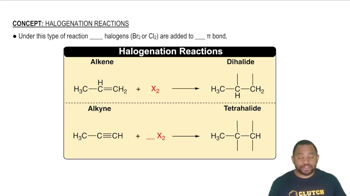
Halogenation Reactions

Oxidation States and Stability

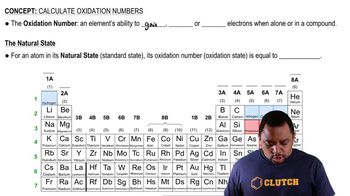
Bismuth can exhibit a +5 oxidation state when reacting with fluorine, which stabilizes the pentahalide BiF5. However, the larger halogens do not stabilize this high oxidation state as effectively, leading to the absence of stable pentahalides with them, as they tend to favor lower oxidation states.
Recommended video:
Guided course
02:42
Oxidation Numbers

Noble Gas Chemistry

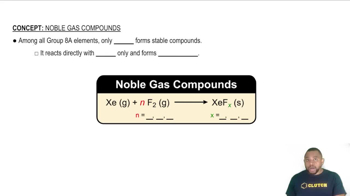
Xenon can form stable compounds with fluorine due to its ability to expand its octet and accommodate higher oxidation states, similar to bismuth. However, xenon does not react with larger halogens because they do not provide the same level of stabilization for high oxidation states, limiting the formation of stable compounds.
Recommended video:
Guided course
00:59
Noble Gas Compounds
Related Practice
Textbook Question

Potassium superoxide, KO2, is often used in oxygen masks (such as those used by firefighters) because KO2 reacts with CO2 to release molecular oxygen. Experiments indicate that 2 mol of KO2(s) react with each mole of CO2(g). (c) What mass of KO2(s) is needed to consume 18.0 g CO2(g)? What mass of O2(g) is produced during this reaction?

1594
views
Textbook Question

One way to measure ionization energies is ultraviolet photoelectron spectroscopy (PES), a technique based on the photoelectric effect. (Section 6.2) In PES, monochromatic light is directed onto a sample, causing electrons to be emitted. The kinetic energy of the emitted electrons is measured. The difference between the energy of the photons and the kinetic energy of the electrons corresponds to the energy needed to remove the electrons (that is, the ionization energy). Suppose that a PES experiment is performed in which mercury vapor is irradiated with ultraviolet light of wavelength 58.4 nm. (d) Using Figure 7.10, determine which of the halogen elements has a first ionization energy closest to that of mercury.

991
views
Textbook Question

When magnesium metal is burned in air (Figure 3.6), two products are produced. One is magnesium oxide, MgO. The other is the product of the reaction of Mg with molecular nitrogen, magnesium nitride. When water is added to magnesium nitride, it reacts to form magnesium oxide and ammonia gas. (d) Magnesium nitride can also be formed by reaction of the metal with ammonia at high temperature. Write a balanced equation for this reaction. If a 6.3-g Mg ribbon reacts with 2.57 g NH31g2 and the reaction goes to completion, which component is the limiting reactant? What mass of H21g2 is formed in the reaction?

1898
views
Textbook Question

Potassium superoxide, KO2, is often used in oxygen masks (such as those used by firefighters) because KO2 reacts with CO2 to release molecular oxygen. Experiments indicate that 2 mol of KO2(s) react with each mole of CO2(g). (a) The products of the reaction are K2CO3(s) and O2(g). Write a balanced equation for the reaction between KO2(s) and CO2(g).

Textbook Question

When magnesium metal is burned in air (Figure 3.6), two products are produced. One is magnesium oxide, MgO. The other is the product of the reaction of Mg with molecular nitrogen, magnesium nitride. When water is added to magnesium nitride, it reacts to form magnesium oxide and ammonia gas. (c) In an experiment, a piece of magnesium ribbon is burned in air in a crucible. The mass of the mixture of MgO and magnesium nitride after burning is 0.470 g. Water is added to the crucible, further reaction occurs, and the crucible is heated to dryness until the final product is 0.486 g of MgO. What was the mass percentage of magnesium nitride in the mixture obtained after the initial burning?

1978
views