
Ch.7 - Periodic Properties of the Elements
Brown - Chemistry: The Central Science 14th Edition
Brown14th EditionChemistry: The Central ScienceISBN: 9780134414232Not the one you use?Change textbook
Chapter 7, Problem 111b

One way to measure ionization energies is ultraviolet photoelectron spectroscopy (PES), a technique based on the photoelectric effect. (Section 6.2) In PES, monochromatic light is directed onto a sample, causing electrons to be emitted. The kinetic energy of the emitted electrons is measured. The difference between the energy of the photons and the kinetic energy of the electrons corresponds to the energy needed to remove the electrons (that is, the ionization energy). Suppose that a PES experiment is performed in which mercury vapor is irradiated with ultraviolet light of wavelength 58.4 nm. (b) Write an equation that shows the process corresponding to the first ionization energy of Hg.

Verified step by step guidance
1
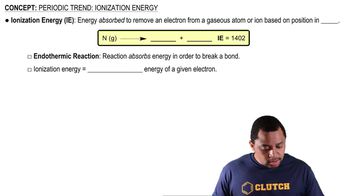
Understand the concept of ionization energy: Ionization energy is the energy required to remove an electron from an atom or ion in its gaseous state.
Identify the process for the first ionization energy: The first ionization energy involves removing the outermost electron from a neutral atom.
Write the general equation for the ionization process: For a generic element X, the equation is X(g) → X⁺(g) + e⁻.
Apply the equation to mercury (Hg): Replace X with Hg to represent the ionization of mercury.
The equation for the first ionization energy of mercury is: Hg(g) → Hg⁺(g) + e⁻.

Verified video answer for a similar problem:

This video solution was recommended by our tutors as helpful for the problem above.
Video duration:
2m
Was this helpful?

Key Concepts

Here are the essential concepts you must grasp in order to answer the question correctly.

Ionization Energy

Ionization energy is the amount of energy required to remove an electron from an atom or ion in its gaseous state. It is a crucial concept in understanding the reactivity and stability of elements, as it influences how easily an atom can lose electrons to form positive ions. The first ionization energy specifically refers to the energy needed to remove the outermost electron from a neutral atom.
Recommended video:
Guided course
01:19
Ionization Energy

Photoelectric Effect

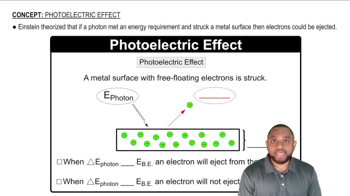
The photoelectric effect is a phenomenon where electrons are emitted from a material when it is exposed to light of sufficient energy. This effect demonstrates the particle nature of light, as photons must have enough energy to overcome the binding energy of electrons in the material. In the context of photoelectron spectroscopy, this principle is used to measure the kinetic energy of emitted electrons, which helps determine ionization energies.
Recommended video:
Guided course
02:31
Photoelectric Effect

Ultraviolet Photoelectron Spectroscopy (PES)

Ultraviolet photoelectron spectroscopy (PES) is an analytical technique used to study the electronic structure of atoms and molecules. In PES, a sample is irradiated with ultraviolet light, causing the emission of electrons. By measuring the kinetic energy of these electrons and knowing the energy of the incident photons, one can calculate the ionization energy of the sample, providing insights into its electronic configuration and chemical properties.
Recommended video:
Guided course
02:31
Photoelectric Effect
Related Practice
Textbook Question

One way to measure ionization energies is ultraviolet photoelectron spectroscopy (PES), a technique based on the photoelectric effect. (Section 6.2) In PES, monochromatic light is directed onto a sample, causing electrons to be emitted. The kinetic energy of the emitted electrons is measured. The difference between the energy of the photons and the kinetic energy of the electrons corresponds to the energy needed to remove the electrons (that is, the ionization energy). Suppose that a PES experiment is performed in which mercury vapor is irradiated with ultraviolet light of wavelength 58.4 nm. (d) Using Figure 7.10, determine which of the halogen elements has a first ionization energy closest to that of mercury.

991
views
Textbook Question

One way to measure ionization energies is ultraviolet photoelectron spectroscopy (PES), a technique based on the photoelectric effect. (Section 6.2) In PES, monochromatic light is directed onto a sample, causing electrons to be emitted. The kinetic energy of the emitted electrons is measured. The difference between the energy of the photons and the kinetic energy of the electrons corresponds to the energy needed to remove the electrons (that is, the ionization energy). Suppose that a PES experiment is performed in which mercury vapor is irradiated with ultraviolet light of wavelength 58.4 nm. (c) The kinetic energy of the emitted electrons is measured to be 1.72 × 10⁻¹⁸ J. What is the first ionization energy of Hg, in kJ/mol?

561
views
Textbook Question

Moseley established the concept of atomic number by studying X rays emitted by the elements. The X rays emitted by some of the elements have the following wavelengths: Element Wavelength (pm) Ne 1461 Ca 335.8 Zn 143.5 Zr 78.6 Sn 49.1 (d) Use the result from part (b) to predict the X-ray wavelength emitted by iron.

552
views
Textbook Question

When magnesium metal is burned in air (Figure 3.6), two products are produced. One is magnesium oxide, MgO. The other is the product of the reaction of Mg with molecular nitrogen, magnesium nitride. When water is added to magnesium nitride, it reacts to form magnesium oxide and ammonia gas. (c) In an experiment, a piece of magnesium ribbon is burned in air in a crucible. The mass of the mixture of MgO and magnesium nitride after burning is 0.470 g. Water is added to the crucible, further reaction occurs, and the crucible is heated to dryness until the final product is 0.486 g of MgO. What was the mass percentage of magnesium nitride in the mixture obtained after the initial burning?

1978
views
Textbook Question

Moseley established the concept of atomic number by studying X rays emitted by the elements. The X rays emitted by some of the elements have the following wavelengths: Element Wavelength (pm) Ne 1461 Ca 335.8 Zn 143.5 Zr 78.6 Sn 49.1 (e) A particular element emits X rays with a wavelength of 98.0 pm. What element do you think it is?

Textbook Question

Moseley established the concept of atomic number by studying X rays emitted by the elements. The X rays emitted by some of the elements have the following wavelengths: Element Wavelength (pm) Ne 1461 Ca 335.8 Zn 143.5 Zr 78.6 Sn 49.1 (b) Plot the square root of n versus the atomic number of the element. What do you observe about the plot? (e) A particular element emits X rays with a wavelength of 98.0 pm. What element do you think it is?

427
views